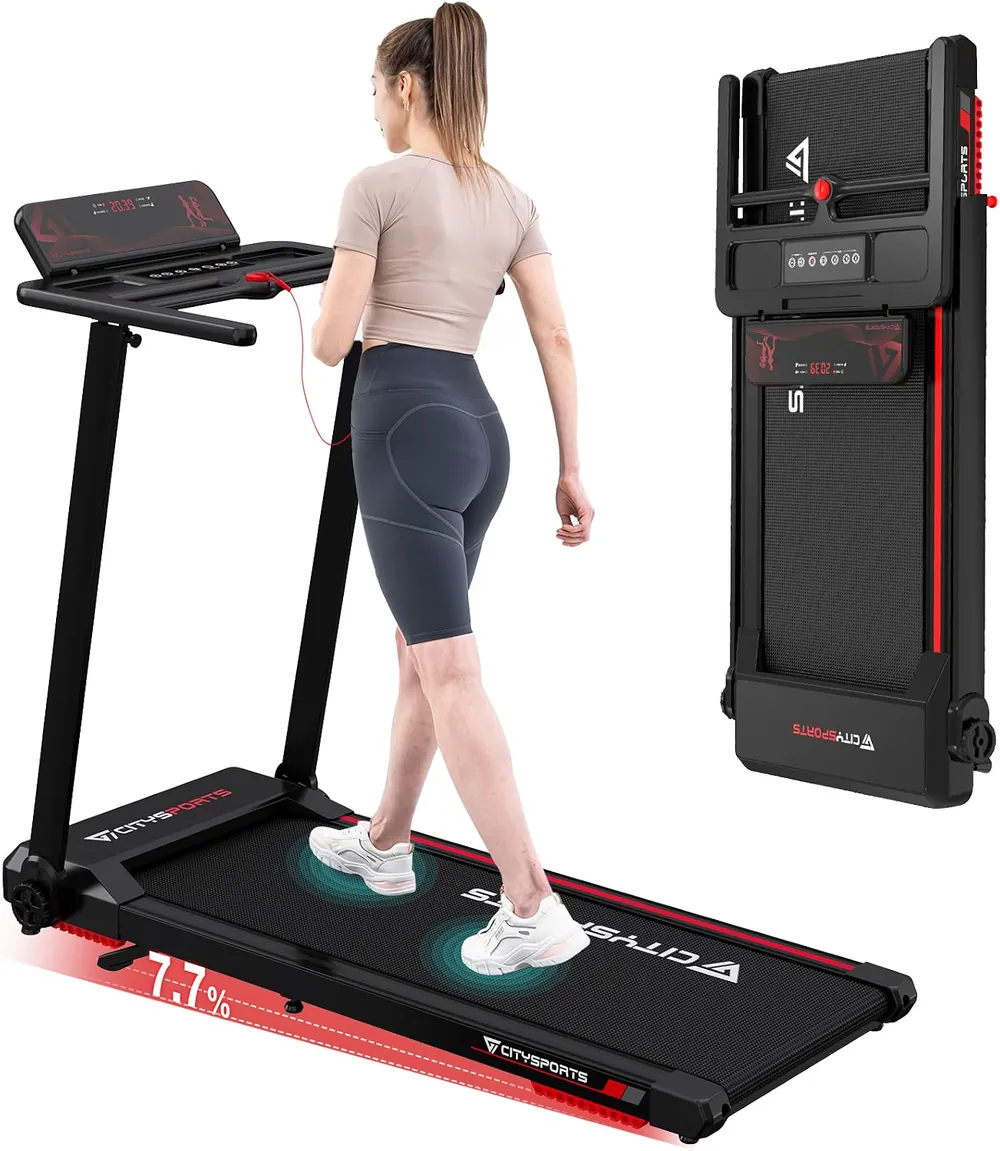
Walking pad or treadmill: which one should you choose?
The walking pad and the folding treadmill look alike in photos, but they do not do the same job. Here is how to know which one fits the way you move, and when a hybrid treadmill like the CITYSPORTS does both.
Contents
The term “walking pad” has taken over shop shelves and work-from-home videos. It refers to an ultra-flat walking treadmill, often without uprights, that you slide under a desk or sofa. The folding treadmill keeps a handrail and goes faster. Between the two, a hybrid category blurs the picture. This guide sorts things out, starting from what you plan to do.
Two machines, two jobs
The walking pad is designed for walking. Its speed most often tops out at around 6 km/h, its console is minimal, and many are operated with a remote control. It is aimed at prolonged use at a slow pace, for example while working or watching television.
The folding treadmill is designed for walking and running. It reaches 10, 12 km/h or more, carries a console on uprights that act as a handrail, and often offers an incline. To save space, its uprights fold down onto the deck or its belt lifts up.
The comparison in one table
| Criterion | Walking pad | Folding treadmill |
|---|---|---|
| Top speed | Often 6 km/h | 10 to 12 km/h or more |
| Handrail | None or very short | Present, often folding |
| Controls | Remote control, app | Console on uprights, shortcuts |
| Under-desk use | Designed for it | Possible depending on height |
| Running | No | Yes, depending on belt length |
| Incline | Rare, sometimes slight | Common, manual or motorised |
| Weight | Often lighter | Often a little heavier |
| Storage | Very flat | Flat or upright, depending on the model |
Speed, the first dividing line
An adult’s usual walking speed is between 4 and 6 km/h. Above 7 to 8 km/h, most people spontaneously break into a run, because walking that fast becomes uncomfortable. A 6 km/h walking pad therefore covers all walking, from strolling to brisk walking, but not running.
If you plan to jog, even rarely, you need a machine that goes above 8 km/h, ideally 10 to 12 km/h to keep a margin. It is the simplest question to ask yourself: will you run, yes or no?
| Speed | Walking pad | 12 km/h treadmill |
|---|---|---|
| 1 to 3 km/h (slow walking) | Yes | Yes |
| 4 to 6 km/h (active walking) | Yes | Yes |
| 7 to 8 km/h (slow running) | Usually no | Yes |
| 9 to 12 km/h (jogging, running) | No | Yes |
With or without a handrail
The handrail is not an accessory. It helps you step on and off the belt, steady yourself after a misstep, and it often carries the console and the safety key slot. For someone getting back into exercise, with fragile balance or wanting to walk uphill, it brings real safety.
It has a downside: it adds height. Under a standing desk, the uprights can get in the way. That is why hybrid treadmills let you fold them down to walk without support at slow speed.
Do not hang on to the handrail for the whole session: it distorts your posture and reduces energy expenditure. It is for occasional support, not a crutch.
Belt and stride
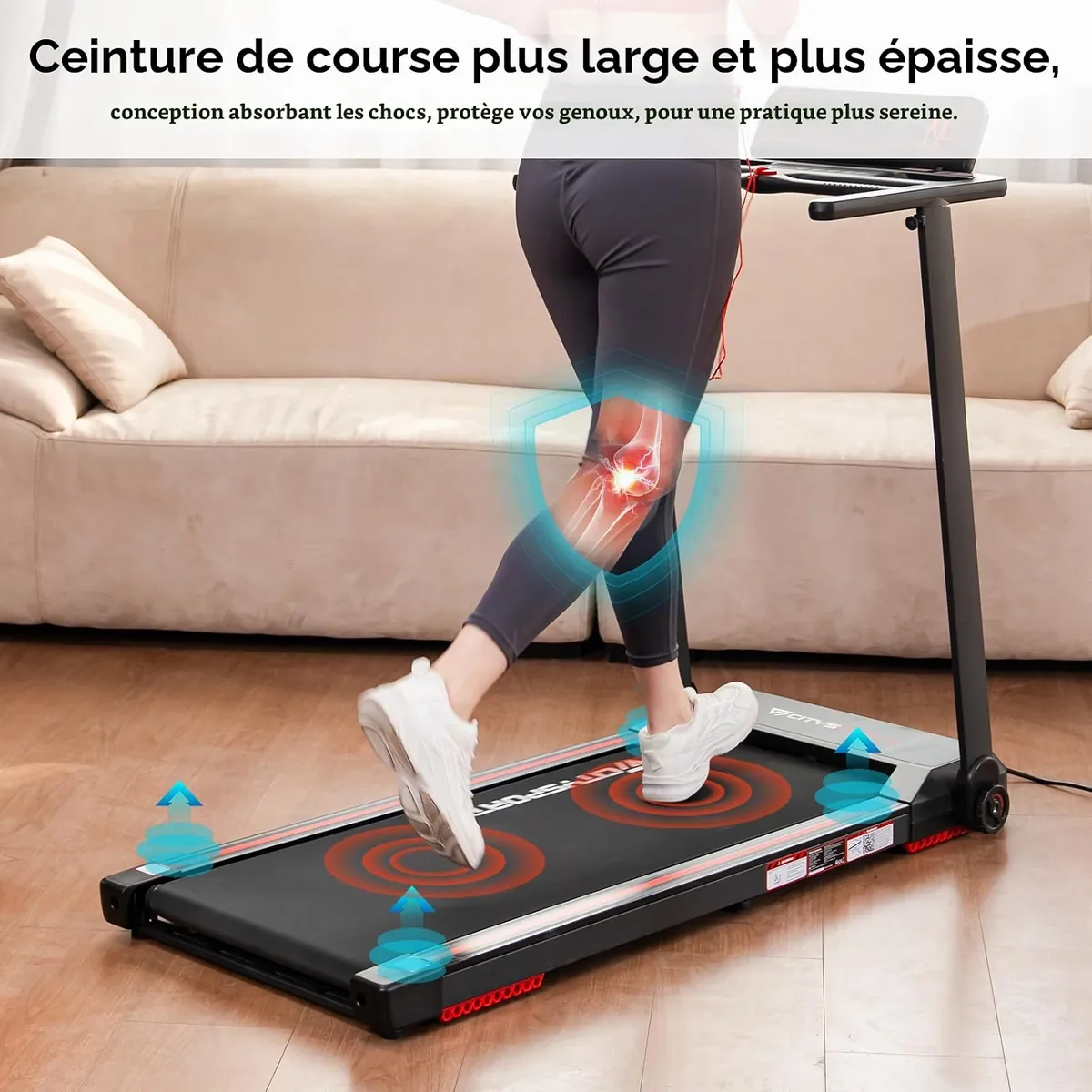
When walking, your stride is short: a belt about 100 cm long is plenty, and width matters more for comfort. When running, your stride lengthens with speed, and belt length becomes decisive.
The CITYSPORTS has a 400 x 1020 mm belt: comfortable for walking, enough for jogging, tight for a long stride at 11 or 12 km/h. One published comparison finds it a little narrow for running between 10 and 12 km/h. Walking pads often have slightly narrower belts, which makes sense: they are not designed for running.
Under a standing desk
This is the walking pad’s home ground. Walking slowly while working increases expenditure and reduces sitting time. The French occupational safety institute INRS notes that these dynamic workstations reduce time spent sitting, but also that fine motor skills, typing and mouse use can be less accurate while walking, particularly on a treadmill. It also mentions a risk of falling and points out that a height-adjustable desk is often essential.
A folding treadmill can also be used under a desk, provided its console does not get in the way. On the CITYSPORTS, the handrail folds down, and speed starts at 1 km/h. Our article walking pad under the desk details the set-up and good practice.
What changes in energy expenditure
Expenditure depends on speed and incline, not on the name of the machine. The Compendium of Physical Activities gives these values for treadmill walking with no incline:
| Speed (treadmill, 0 %) | MET | For 70 kg and 30 min |
|---|---|---|
| 3.2 to 3.9 km/h | 3.0 | about 105 kcal |
| 4.8 to 5.5 km/h | 3.8 | about 133 kcal |
| 5.6 to 6.3 km/h | 4.8 | about 168 kcal |
| 6.4 to 7.1 km/h | 5.8 | about 203 kcal |
Beyond that, running pushes expenditure up: 8.5 METs between 8.0 and 8.4 km/h according to the Compendium. But for health, weekly volume comes first. A walking pad used two hours a day at 3 km/h can bring more benefit than a treadmill sleeping under the bed. Try our calculator to compare your scenarios.
Storage and footprint
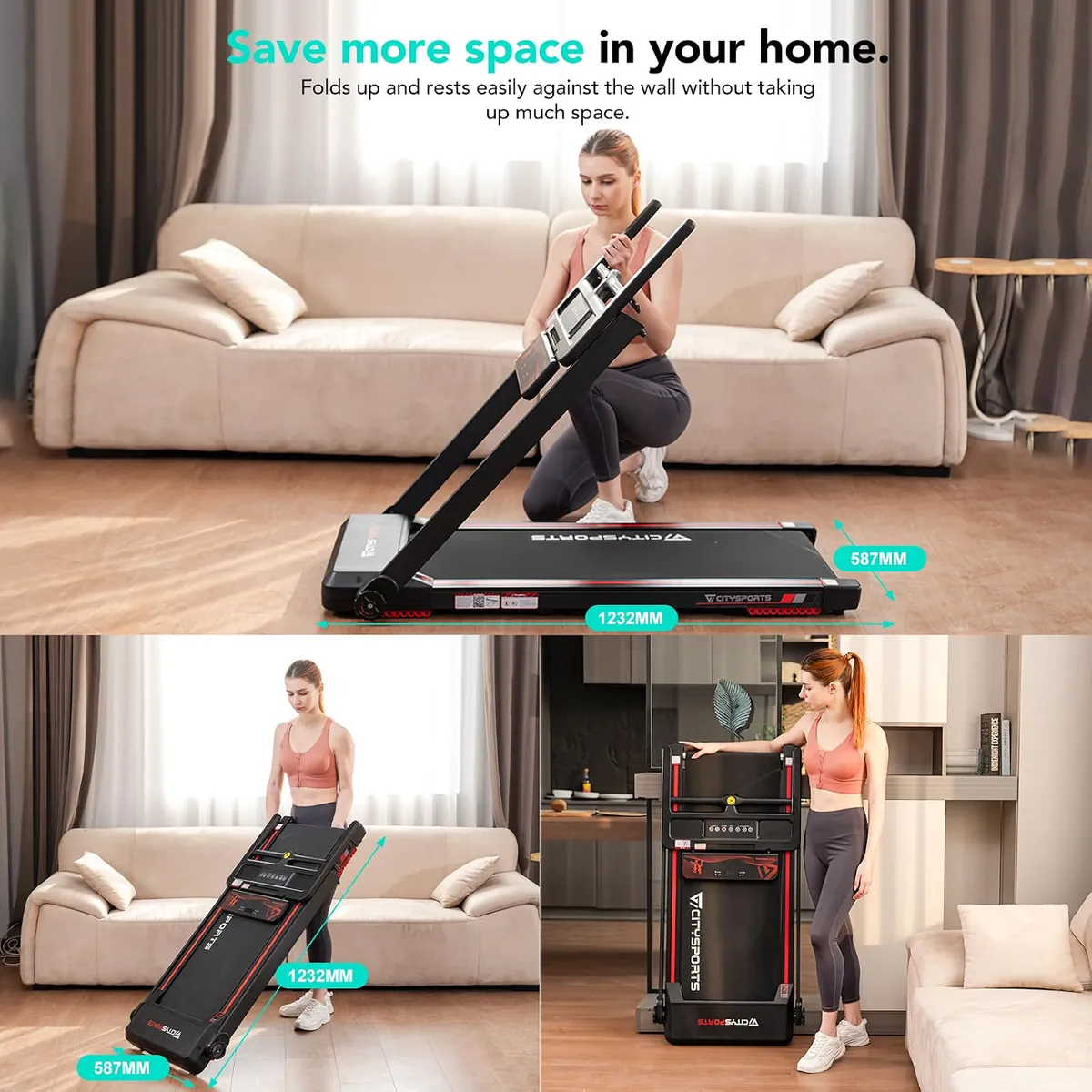
The walking pad is unbeatable for thickness: it slides under almost any sofa. The compact treadmill with a folding handrail also stores flat, a little thicker, or upright against a wall. The CITYSPORTS takes up about 1232 x 587 mm of floor folded according to the manufacturer’s images and weighs 26.5 kg. Lift-up deck treadmills remain the bulkiest.
Measure the height available under the furniture you have in mind before buying: it is the most common cause of disappointment.
Noise and neighbours
At walking speed, a walking pad and a treadmill make comparable noise: a slight motor hum and the glide of the belt. The difference comes from use: running produces impacts that the neighbours below can hear. If you live upstairs and can only exercise in the evening, a walking machine naturally limits that risk. Our article a quiet treadmill in a flat gives the solutions.
The hybrid treadmill
Some treadmills try to combine both worlds: a low deck like a walking pad, a folding handrail and a running speed. The CITYSPORTS is an example: you can walk at 1 or 3 km/h, handrail down or up, and go up to 12 km/h to jog.
This compromise has obvious advantages: one machine, from desk to jog. It also has limits: the belt is still that of a compact treadmill, and the incline is manual. For most buyers who mainly walk and run a little, it is the best balance. For a regular runner, it is only a back-up machine. Our CITYSPORTS review details this compromise.
How to decide
- You will never run and want to walk while working: a walking pad.
- You mostly walk and want an incline or support: a compact treadmill with a handrail.
- You walk and jog: a hybrid or compact treadmill that reaches 10 or 12 km/h.
- You run regularly above 10 km/h: a treadmill with a long belt and a continuous-rated motor, even if it takes up more room.
For the other criteria, our guide how to choose a folding treadmill covers everything.
Heavy use: what wears each machine
A walking pad used several hours a day at 2 or 3 km/h and a treadmill used one hour a day at 10 km/h do not wear in the same way. The first runs its motor for a long time at light load; the second pushes it harder for a shorter time, with much greater impacts on the deck and frame.
In both cases, three factors speed up wear: a user weight close to the maximum load, a belt that is poorly lubricated or too tight, and dust. If you plan to use your machine several hours a day, check that the manufacturer does not limit continuous use, and follow the schedule in our maintenance guide.
Over 60: which machine?
For many people over 60, walking is the main activity, and safety comes first. Three things then matter more than top speed:
- A sturdy handrail for stepping on and off and steadying yourself;
- A low minimum speed, for a gentle start;
- A safety key and a stop button that are easy to reach.
These criteria often tip the balance towards a treadmill with a handrail rather than a walking pad without uprights. The meta-analysis by Paluch et al. (2022) puts the benefit plateau at around 6,000 to 8,000 steps a day after 60: a target within reach with a few walking sessions on a treadmill. The Compendium also publishes specific values for people over 60, because their expenditure differs from that of younger adults. If you have balance problems or a chronic illness, ask a doctor for advice.
Tall and heavier users
The most compact walking pads often have a shorter belt and a lower maximum load. For a tall or heavier person, those two figures become decisive. Use the lowest maximum load if the listing gives two, as is the case for the CITYSPORTS (120 kg in the description, 110 kg in the specification table), and keep a comfortable margin. For long strides, even when walking briskly, a long belt is more comfortable.
What if your needs change?
Many buyers start by walking, then feel like jogging after a few months. If that seems likely, a machine that reaches 10 or 12 km/h saves you buying another treadmill. Conversely, if you know you will never run, there is no point paying in footprint and weight for a speed you will not use. A hybrid treadmill is often the safest choice when you are unsure: it walks well today and leaves the door open to running tomorrow.
Trying before you buy
If you can, try both types of machine before buying, in a shop or a gym. Walk for a few minutes at your usual pace on a walking pad, then on a treadmill with a handrail. Notice whether you need to watch your feet, whether you reach for support, and how the belt feels underfoot. If you plan to run, jog for a minute and see whether your stride feels cramped. These few minutes tell you more than any listing. When buying online, the 14-day cancellation period partly plays the same role: try the machine at home during the first days and keep the box.
Frequently asked questions
Can you run on a walking pad?
Most top out at around 6 km/h, a brisk walking speed. They are not designed for running.
Can a treadmill be used under a desk?
Yes, if the console does not get in the way and the speed starts low. On models with a folding handrail, you can lower it to walk under the desk.
Which one burns more calories?
At the same speed, neither: expenditure depends on speed, incline and duration. A treadmill simply lets you go faster.
Which one is quieter?
When walking, they are comparable. It is the impact of running that makes the difference.
Is the CITYSPORTS treadmill a walking pad?
It is a hybrid: a compact treadmill that folds like a walking pad, with a handrail and a speed of up to 12 km/h.
Is the handrail essential?
Not for walking slowly when in good shape; yes for many people getting back into exercise, walking uphill or running.
Is a walking pad suitable for an older person?
For someone with good balance, yes, at slow speed. For someone who needs support, a treadmill with a handrail is more reassuring.
Which one lasts longer?
It depends mainly on use, the user’s weight and maintenance, more than on the type of machine.
Which machine for a small studio flat?
The walking pad is the flattest. A compact treadmill with a folding handrail can still be stored flat or upright, with more versatility.
Can you run on a walking pad by pushing it to the max?
No. At 6 km/h you are walking briskly; forcing a run on a short belt without a handrail increases the risk of falling.
Do you need an incline on a walking pad?
It is not common. If uphill walking interests you, a compact treadmill with an incline, even a manual one, is better suited.
Can you walk while working from home on the CITYSPORTS treadmill?
Yes, it starts at 1 km/h and has a 3 km/h shortcut. Check that its height suits your desk.
Is a walking pad enough to reach the WHO recommendation?
Yes, if you walk briskly enough: active walking at 5 km/h and above counts as moderate activity. Slow walking under a desk counts mostly as light activity.
Which is easier to move around the home?
The walking pad, which is usually lighter and flatter. A compact treadmill on wheels like the CITYSPORTS, at 26.5 kg, can still be rolled by one person.
Your next kilometre starts here.
12 km/h · 1400 W · 400 x 1020 mm belt · Bluetooth · No assembly. The price changes often on Amazon: check it, along with the seller and the stated maximum load, before ordering.
Check the price on AmazonAffiliate link · new tab