Treadmill calculator: calories, distance and WHO benchmark
Enter your weight and the duration and pace of your sessions. The calculator estimates your expenditure using values from the Compendium of Physical Activities and the distance covered, compares it with the WHO benchmark and checks compatibility with the CITYSPORTS treadmill’s maximum load.
Treadmill calculator: calories, distance and WHO benchmark
Enter your weight and the duration and pace of your sessions: we estimate energy expenditure with MET values from the Compendium of Physical Activities, the distance covered, and compare your week with the WHO benchmark.
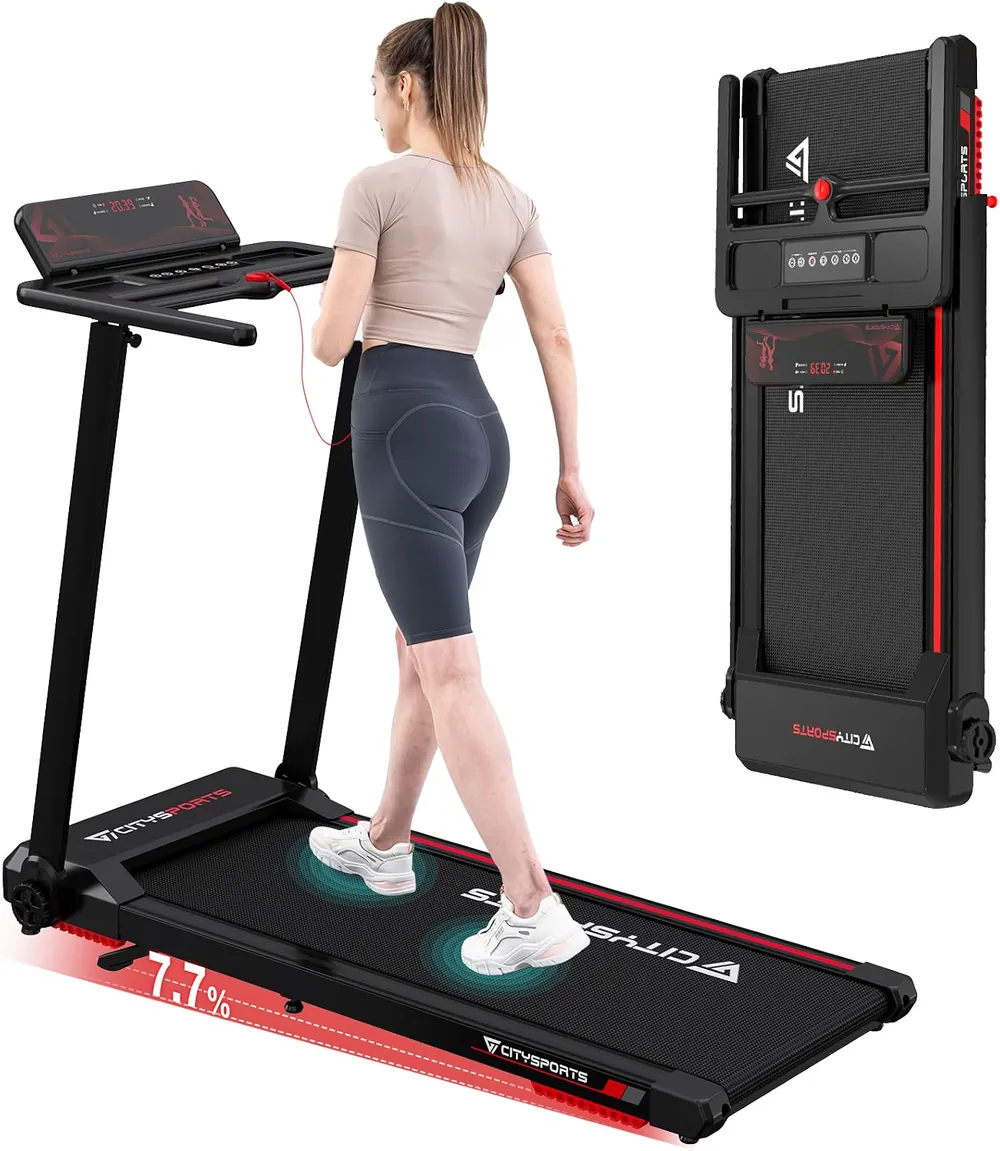
Up to 12 km/h, 3-6-9 shortcuts, a 400 x 1020 mm belt and a folding handrail: enough to walk every day and jog, then slide the treadmill under furniture.
- 12 km/h
- 400 x 1020 mm
- 26.5 kg
Our calculation method
The calculator measures nothing: it applies published formulas, which we set out here so you can check them. Its results are orders of magnitude, useful for planning, not laboratory measurements.
Energy expenditure
We use the metabolic equivalent, or MET. One MET corresponds to the expenditure of a person at rest, sitting. An activity at 4 METs therefore requires about four times as much energy as rest. The usual formula is:
expenditure (kcal) = MET x weight (kg) x duration (hours)
MET values come from the 2024 edition of the Compendium of Physical Activities (Herrmann et al., Journal of Sport and Health Science), available on pacompendium.com. For treadmill walking with no incline, it gives:
| Treadmill walking, 0 % incline (Compendium 2024) | MET | Pace in the calculator |
|---|---|---|
| 1.9 to 3.1 km/h | 2.8 | Not used |
| 3.2 to 3.9 km/h | 3.0 | Slow walk |
| 4.0 to 4.7 km/h | 3.5 | Easy walk |
| 4.8 to 5.5 km/h | 3.8 | Active walk |
| 5.6 to 6.3 km/h | 4.8 | Brisk walk |
| 6.4 to 7.1 km/h | 5.8 | Very brisk walk |
| 7.2 to 7.9 km/h | 6.8 | Not used |
| 8.0 to 8.9 km/h | 8.3 | Not used |
For running, we use the values from the Compendium’s running section, given in miles per hour and converted here to km/h:
| Running (Compendium) | MET | Pace in the calculator |
|---|---|---|
| 5.0 to 5.2 mph, i.e. 8.0 to 8.4 km/h | 8.5 | Slow run |
| 5.5 to 5.8 mph, i.e. 8.9 to 9.3 km/h | 9.0 | Run |
| 6.0 to 6.3 mph, i.e. 9.7 to 10.1 km/h | 9.3 | Run |
| 7 mph, i.e. about 11.3 km/h | 11.0 | Steady run |
| 7.5 mph, i.e. about 12.1 km/h | 11.8 | Fast run (12 km/h) |
Example: a 70 kg person walking for 30 minutes at 5 km/h burns about 3.8 x 70 x 0.5 = 133 kcal. This value is “gross”: it includes the energy the body would have used at rest anyway during those 30 minutes.
Distance
Distance is simply speed multiplied by duration. We use the middle of each pace range: 5.15 km/h for an active walk, for example. It matches what the console shows, allowing for calibration differences.
Choosing your pace
On a treadmill, the speed is displayed: no need to guess. To place yourself, the talk test is still a good guide:
- Slow or easy walk: you can talk effortlessly, you could sing.
- Active or brisk walk: you speak in short sentences, your breathing quickens.
- Running: you can only say a few words at a time.
The WHO benchmark
The World Health Organization guidelines recommend that adults do 150 to 300 minutes of moderate-intensity aerobic activity per week, or 75 to 150 minutes of vigorous intensity, or a combination of both, with muscle strengthening on at least two days a week. The WHO points out that any activity is better than none.
The calculator converts your sessions into “moderate minutes”. By convention, an activity of 3 to under 6 METs is moderate and counts once; an activity of 6 METs or more is vigorous and counts twice, in line with the WHO equivalence. Slow walking at 3.0 METs already counts as moderate activity. The total is compared with 150, the bottom of the recommended range.
Compatibility with the CITYSPORTS treadmill
The CITYSPORTS treadmill documents give two maximum loads: 120 kg in the description, 110 kg in the Amazon specification table. The calculator uses three zones: up to 110 kg, the treadmill suits you; between 110 and 120 kg, the margin is small; above that, it does not suit you. It is not just about comfort: the maximum load affects safety and motor life.
What about the incline?
The calculator does not take the incline into account. The 2024 Compendium gives no value for uphill treadmill walking at these speeds, and we prefer not to invent a coefficient. Simply remember that walking on a 7.7 % gradient takes noticeably more energy than on the flat at the same speed: your real expenditure will be higher than the figure shown.
To reproduce outdoor running, a study by Jones and Doust (1996, Journal of Sports Sciences) showed that a 1 % gradient makes up for the lack of air resistance. On a treadmill with a manual incline, that fine adjustment is not always possible: it is a difference worth knowing, not a problem for walking.
The limits of these estimates
- MET values are averages: for the same effort, two people do not burn exactly the same energy.
- The 2024 edition of the Compendium is for adults aged 19 to 59; a specific version exists for people over 60, with different values.
- Holding the handrail reduces expenditure compared with the values in the table.
- The treadmill console’s calories are calculated differently, often without your weight: differences are normal.
- The calculator does not take your health into account. If in doubt, ask a professional.
How to use these results
Use the calculator to plan, not to count every calorie. If your weekly total is far below the 150-minute benchmark, first add a short session rather than lengthening the others. If your goal is to lose weight, remember that one session does not make up for a big dietary excess: consistency over several months is what makes the difference. Our articles beginner plans and treadmill for weight loss offer practical plans, and our guide walking pad under the desk explains how to add minutes without thinking about it.
Sources
- Herrmann et al., 2024 Adult Compendium of Physical Activities, Journal of Sport and Health Science, and the pacompendium.com website (walking and running sections).
- World Health Organization, guidelines on physical activity and sedentary behaviour (2020).
- Jones A. M. and Doust J. H., A 1 % treadmill grade most accurately reflects the energetic cost of outdoor running, Journal of Sports Sciences, 1996.
- CITYSPORTS, Amazon product listing (maximum load) and manufacturer’s website.
Your next kilometre starts here.
12 km/h · 1400 W · 400 x 1020 mm belt · Bluetooth · No assembly. The price changes often on Amazon: check it, along with the seller and the stated maximum load, before ordering.
Check the price on AmazonAffiliate link · new tab