Treadmill plans: starting out, progressing, keeping it up
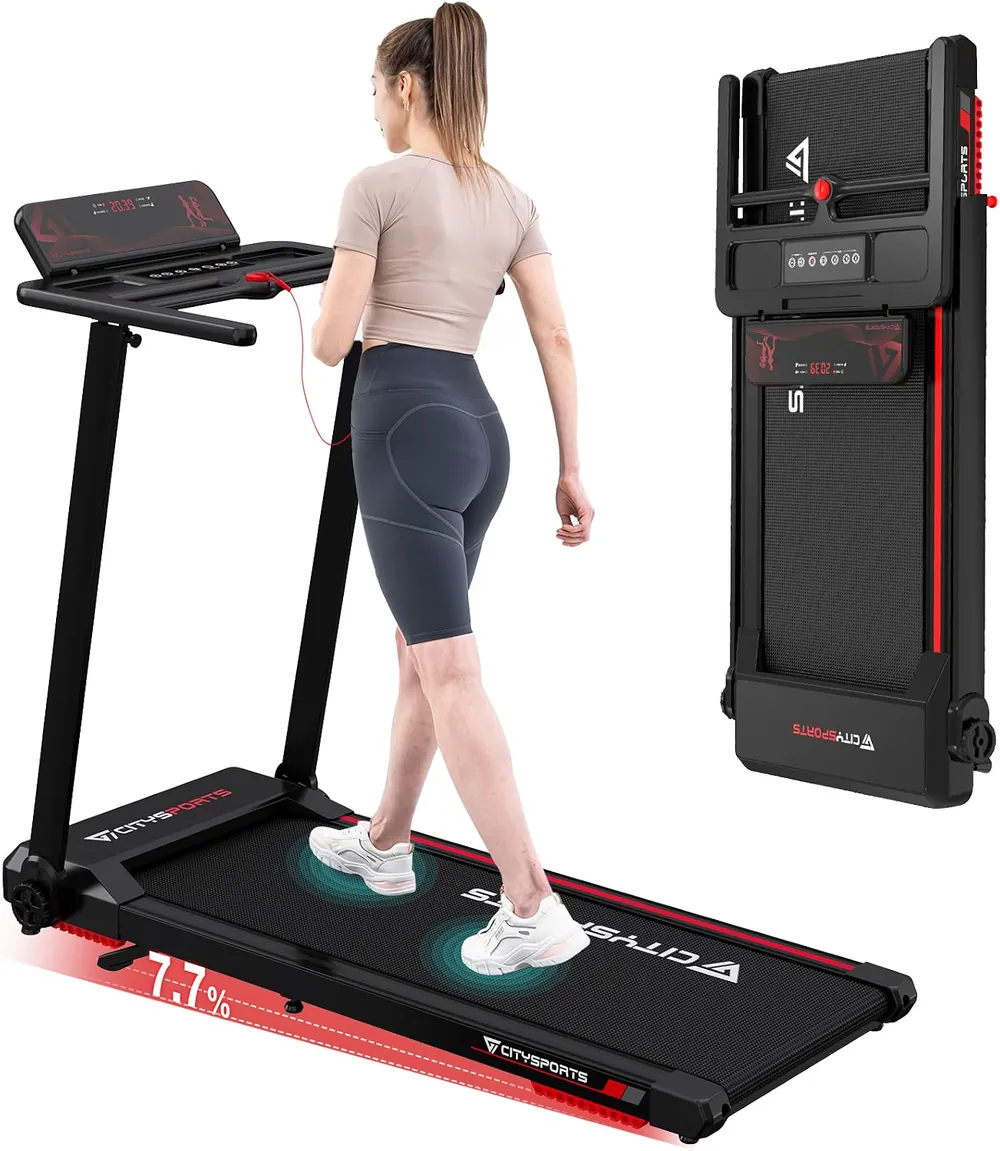
Practical sessions, from the first 15-minute walk to a 30-minute jog, with the speeds, inclines and durations to set on a treadmill like the CITYSPORTS. The aim is not to suffer for a week, but to still be moving in six months.
Contents
Before you start: if you are returning to exercise after a long break, have a heart, respiratory or joint condition, are pregnant or feel chest pain, unusual breathlessness or faintness during exercise, ask a doctor for advice. These plans are general examples, not a prescription.
Principles before plans
A plan is only useful if you follow it. The finest plans fail for a simple reason: they ask too much, too soon. Before choosing sessions, remember five principles that apply at every level.
- Consistency beats intensity. Three moderate sessions a week for six months are worth far more than six exhausting sessions for two weeks.
- Duration before speed. Lengthen your sessions first, then speed up. The heart adapts quickly, tendons and joints more slowly.
- One variable at a time. Each week, increase duration, speed or incline, never all three.
- Lighter weeks. Every three or four weeks, reduce the volume a little to let your body absorb the work.
- Comfort first. A session should leave you tired but able to go again the next day.
The treadmill has an advantage over the road: speed is exact and constant, the surface is even, the weather does not matter. It is an excellent tool for learning to pace your effort. It also has a trap: you can raise the speed with one finger, with no transition. The CITYSPORTS’s 3, 6 and 9 km/h shortcuts are handy, but go through intermediate steps when you speed up a lot.
Gauging intensity without a heart-rate monitor
You do not need a heart-rate watch to pace your effort. The talk test is simple and reliable for most people:
| Zone | Talk test | How it feels | On the treadmill, for many beginners |
|---|---|---|---|
| Light | You can sing | Easy, calm breathing | Walking at 3 to 4 km/h |
| Moderate | You speak in short sentences | Faster breathing, light sweating | Walking at 5 to 6 km/h, or uphill walking |
| Vigorous | You can only say a few words | Clearly out of breath | Slow running or brisk uphill walking |
| Very vigorous | You can no longer speak | Maximal effort, a few dozen seconds | Interval sprints |
The speeds in the last column are only a guide: a trained walker will stay in the moderate zone at 6 km/h, while a sedentary person will already be there at 4.5 km/h. Trust how it feels rather than the number.
The Compendium of Physical Activities offers another angle: treadmill walking with no incline is worth 3.0 METs between 3.2 and 3.9 km/h, 3.8 METs between 4.8 and 5.5 km/h and 4.8 METs between 5.6 and 6.3 km/h. By convention, an activity of 3 to 6 METs is moderate, and above that it is vigorous. In other words, an active walk on a treadmill already counts as moderate activity for an average adult.
Health benchmarks: WHO, Anses, step count
Three benchmarks help you set realistic goals.
The WHO: 150 to 300 minutes a week
The World Health Organization guidelines recommend that adults do at least 150 to 300 minutes of moderate-intensity aerobic activity a week, or 75 to 150 minutes of vigorous intensity, or a combination of both. They add muscle strengthening on at least two days a week, and point out that any activity is better than none. One minute of vigorous activity counts roughly as two minutes of moderate activity.
Anses: breaking up sitting time
The French health agency Anses published new recommendations on sedentary behaviour in 2025: interrupt sitting every 30 minutes with 3 to 5 minutes of walking, or with movements that engage the body enough. This benchmark does not replace the WHO’s 150 minutes, it adds to it.
Steps: a benchmark, not a dogma
A meta-analysis of 15 cohorts published in 2022 in The Lancet Public Health found a progressive fall in mortality with daily steps, up to about 6,000 to 8,000 steps in people over 60 and 8,000 to 10,000 in those under 60. The 10,000-step figure, the authors note, comes from a Japanese marketing campaign, not a study. If you start from 3,000 steps, aiming for 5,000 and then 7,000 is already real progress.
Warm-up and cool-down
On a treadmill, warming up comes naturally: you start slowly and speed up.
- Warm-up: 5 minutes of walking, starting at 3 km/h and adding 0.5 km/h per minute up to your session pace. For a running session, add 2 to 3 minutes of brisk walking before jogging.
- Cool-down: 3 to 5 minutes of walking, slowing gradually to 3 km/h. Do not jump off the belt at full speed.
- Stretching: gentle, after the session, for the calves, thighs and hips. It does not prevent stiffness, but it helps you feel looser.
Before each session: safety key clipped on, belt started while straddling the side rails, step onto the belt at slow speed. Our how-to guide details these steps.
The six standard sessions
All the plans below combine six basic sessions. Speeds are a guide: adjust them with the talk test.
| Session | Content | Duration | Intensity |
|---|---|---|---|
| A. Easy walk | Steady pace, conversation possible | 15 to 30 min | Light to moderate |
| B. Active walk | Sustained pace, short sentences | 20 to 45 min | Moderate |
| C. Uphill walk | Manual incline, slow to moderate pace | 15 to 30 min | Moderate to vigorous |
| D. Walk and run | Alternating blocks of slow running and walking | 20 to 35 min | Moderate to vigorous |
| E. Jog | Continuous slow running | 15 to 40 min | Vigorous |
| F. Intervals | Short bursts and recoveries | 20 to 30 min | Vigorous to very vigorous |
Plan 1: 8 weeks of walking
Who it is for: you are starting from little or no activity, you want to walk, not necessarily run one day. Goal: 150 minutes of moderate walking a week by the end of the plan.
| Week | Sessions | Content | Total |
|---|---|---|---|
| 1 | 3 | A: 15 min at 4 km/h | 45 min |
| 2 | 3 | A: 20 min at 4 to 4.5 km/h | 60 min |
| 3 | 4 | 2 x A 20 min; 2 x B 20 min at 5 km/h | 80 min |
| 4 (lighter) | 3 | A 20 min; B 20 min; A 25 min | 65 min |
| 5 | 4 | B 25 min; C 15 min uphill at 3.5 km/h; B 25 min; A 30 min | 95 min |
| 6 | 4 | B 30 min; C 20 min; B 30 min; A 35 min | 115 min |
| 7 | 5 | B 30 min; C 20 min; B 30 min; C 20 min; A 35 min | 135 min |
| 8 | 5 | B 35 min; C 25 min; B 30 min; C 20 min; B 40 min | 150 min |
If a week feels too hard, repeat it instead of moving on. If it feels easy, keep the plan as it is: the aim is to build a habit, not to break a record.
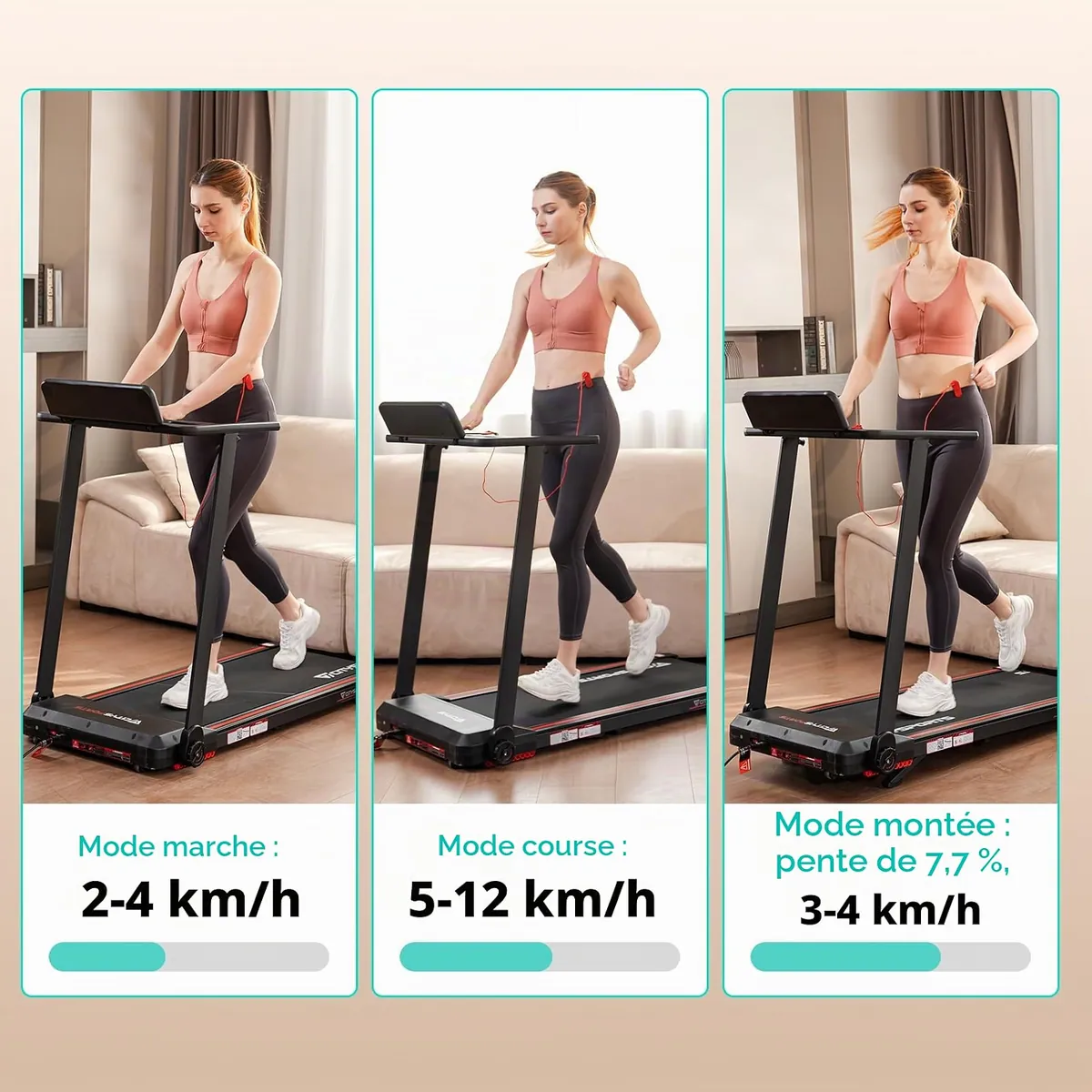
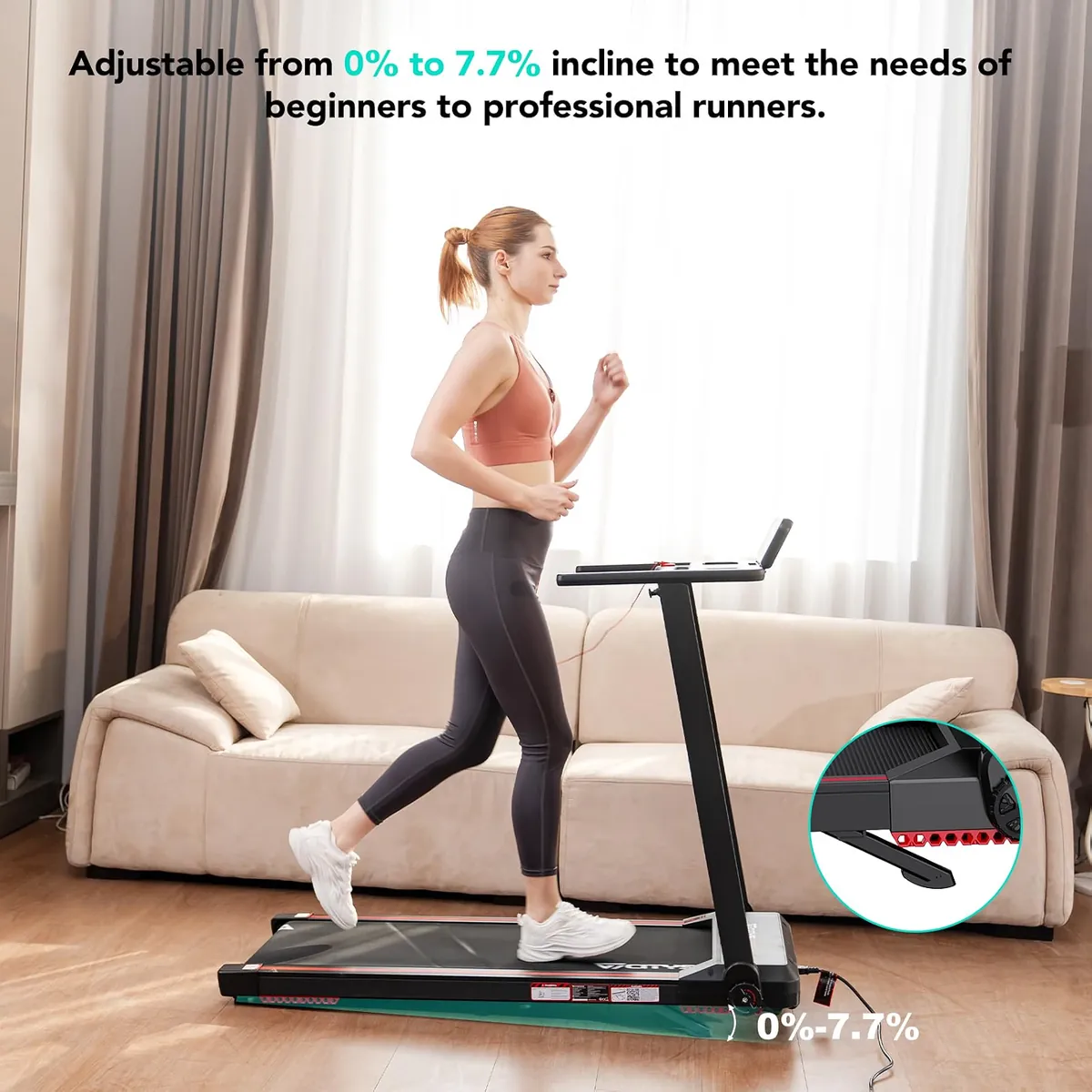
For uphill walking (session C), set the incline before starting: on the CITYSPORTS, it is manual, up to 7.7 %, and set with the treadmill stopped. The manufacturer’s images show a “climb mode” at 3 or 4 km/h: that is a good starting point.
Plan 2: from walking to jogging in 8 weeks
Who it is for: you can already walk 30 minutes without difficulty and want to run 20 to 30 minutes non-stop. Goal: a continuous 25 to 30 minute jog by the end of the plan.
The principle: alternate blocks of slow running and active walking, increasing the share of running. Slow running is often between 7 and 9 km/h for a beginner; recovery walking between 5 and 5.5 km/h. The CITYSPORTS’s 9 km/h shortcut can be used for running, but speeding up in steps from 6 km/h is more comfortable at first.
| Week | Typical session D (3 times a week) | Total running |
|---|---|---|
| 1 | 6 x (1 min running, 2 min walking) | 6 min |
| 2 | 6 x (1 min 30 running, 2 min walking) | 9 min |
| 3 | 5 x (2 min running, 2 min walking) | 10 min |
| 4 (lighter) | 6 x (1 min 30 running, 1 min 30 walking) | 9 min |
| 5 | 4 x (4 min running, 2 min walking) | 16 min |
| 6 | 3 x (6 min running, 2 min walking) | 18 min |
| 7 | 2 x (10 min running, 2 min walking) | 20 min |
| 8 | E: 25 min of continuous slow running | 25 min |
Each session starts with 5 minutes of walking and ends with 5 minutes of slow walking. In addition to the three running sessions, add one or two active walking sessions: they maintain endurance without loading the tendons.
One point to watch on a compact treadmill: the CITYSPORTS belt is 102 cm long. For slow running, that is enough. Keep a short stride and stay in the middle of the belt, especially when you speed up.
Plan 3: moving while working from home
Who it is for: you work from home, sitting most of the time. Goal: apply the Anses recommendation and add 60 to 120 minutes of slow walking per home-working day, without a “workout”.
| When | Activity | Setting |
|---|---|---|
| Every 30 min | 3 to 5 min of walking | Shortcut 3 km/h, then 3.5 to 4 km/h |
| Phone calls | Walk during the call | 2.5 to 3.5 km/h |
| Reading, simple emails | Slow walking under the desk | 1.5 to 3 km/h |
| Lunch break | 15 to 20 min of active walking | 5 km/h |
| End of the day | Session B or C | As in plan 1 |
The French occupational safety institute INRS points out that typing and mouse handling can be less accurate while walking, and that a height-adjustable desk is often necessary. Keep tasks that require precision for when you are sitting or standing still. Our article walking pad under the desk details the set-up.
Using the incline wisely
Walking uphill clearly increases effort without increasing speed or impact on the ground. It is the ideal tool for:
- people who do not want to, or cannot, run;
- people who are overweight, for whom running puts heavy stress on the body;
- walkers preparing for a mountain hike;
- those living upstairs who want to limit impact noise.
On a treadmill with a manual incline like the CITYSPORTS (up to 7.7 %), you choose the gradient before the session. Start at 3 km/h and raise the speed until you are in the moderate zone on the talk test. Do not hold the handrail: it removes much of the effort. The 2024 Compendium publishes no MET value for uphill treadmill walking at these speeds; our calculator therefore ignores the incline, and your real expenditure will be higher than the figure shown.
Interval training on a treadmill
Interval training alternates short, intense efforts with recoveries. It improves cardiorespiratory fitness in little time, but it is more tiring: one session a week is enough, and only after a few weeks of regular running.
| Session | Structure | Level |
|---|---|---|
| F1 “30-30 walk” | 8 x (30 s very brisk walking, 30 s slow walking) | Beginner |
| F2 “1-2” | 6 x (1 min running at a sustained pace, 2 min walking) | Intermediate |
| F3 “pyramid” | 1-2-3-2-1 min of sustained running, 1 min 30 walking between each | Intermediate |
| F4 “hill” | 6 x (2 min brisk uphill walking, 2 min slow walking on the flat) | All levels, incline set when stopped |
On a treadmill, speed changes take a few seconds: count them in the recovery. Never step off the moving belt to “cut short” a recovery. The Compendium gives 8.8 METs for high-intensity interval cycling, but has no exact equivalent for the treadmill: do not try to put a precise figure on the expenditure of an interval session.
Strength training, the other half
The WHO recommends muscle strengthening on at least two days a week. It protects the joints, helps preserve muscle mass when losing weight and makes running more economical. Twenty minutes on the floor, straight after a treadmill session, is enough:
- Squats: 3 sets of 10 to 15, keeping your back straight.
- Forward lunges: 3 sets of 8 per leg.
- Calf raises: 3 sets of 15, for the calves and Achilles tendons.
- Plank: 3 times 20 to 40 seconds, front and sides.
- Glute bridge: 3 sets of 12.
Do not do these exercises on the treadmill belt, even when it is stopped: it can move underfoot.
How to progress afterwards
After eight weeks, you have a habit. To keep progressing without injury:
- Increase volume by no more than 10 % a week, a cautious benchmark commonly used by coaches.
- Vary your sessions: one long, one uphill, one interval, the rest active walking.
- Aim for the top of the WHO range, 300 minutes of moderate walking a week, if your schedule allows.
- Go outside now and then: the road works your ankles and balance differently. A study by Jones and Doust (1996) showed that a 1 % treadmill gradient best reproduces the energy cost of running outdoors.
If your goal becomes regular running above 10 km/h, be aware that a compact treadmill with a 102 cm belt will reach its limits. That is the time to think about a larger machine, or to run outdoors for long sessions.
Recovery, sleep and pain
The body progresses during recovery, not during effort. A few simple rules:
- At least one full rest day a week, two at the start of a running plan.
- No two hard running sessions on consecutive days.
- Sleep matters as much as the session: a short night makes effort harder.
- Hydration: drink before, during long sessions and after. An indoor treadmill makes you sweat quickly.
Some stiffness in the first few days is normal. A sharp, localised pain that persists or worsens with effort is not: stop and see a professional. The areas most often affected in beginners who run are the shins, calves, Achilles tendons and knees, often after increasing volume too quickly.
Keeping it up
Most abandoned treadmills were abandoned within the first three months. A few tips help you get past that point:
- Set appointments: same days, same time. Habit replaces motivation.
- Leave the treadmill visible and ready to use if possible: folding it every day adds a small barrier.
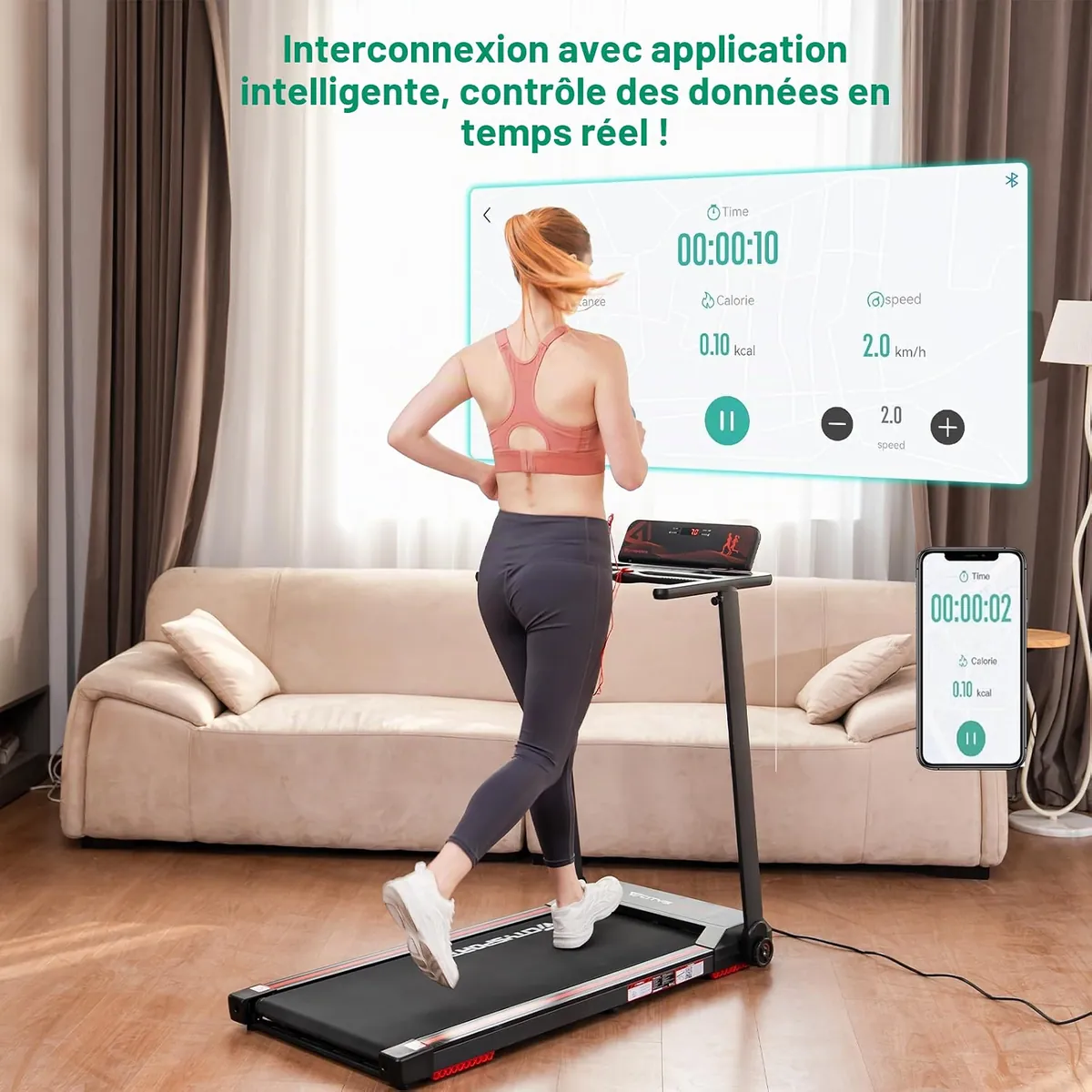
- Link the session to a pleasure: a series kept for the treadmill, a podcast, a playlist. The CITYSPORTS’s tablet holder and Bluetooth speaker are there for that.
- Log your sessions: a notebook or the treadmill’s app. Seeing your weeks fill up is motivating.
- Accept imperfect weeks: a missed session ruins nothing. Simply pick up the plan again.
Common mistakes
- Starting with running when you cannot yet walk 30 minutes easily.
- Holding the handrail all the time: you lean, burn less and pick up bad habits.
- Using the 9 km/h shortcut while walking: the sudden acceleration can throw you off balance.
- Increasing speed, duration and incline in the same week.
- Skipping the warm-up to save five minutes.
- Forgetting the safety key.
- Taking console calories literally and “rewarding yourself” accordingly.
- Giving up after a bad week.
Useful equipment
- A treadmill suited to your use: for walking and jogging, a 10 to 12 km/h folding treadmill like the CITYSPORTS is enough.
- Trainers that are clean and kept for indoor use.
- An anti-vibration mat if you live upstairs.
- A fan: heat is the number one enemy of indoor sessions.
- A water bottle within reach, placed off the belt.
- A towel to wipe sweat off the console after the session.
Plan 4: walking uphill without running
Who it is for: you do not want to run, or your joints do not tolerate it well, but you want a real endurance session. The principle: the incline replaces speed. On a treadmill with a manual incline like the CITYSPORTS, set the gradient before you start.
| Weeks | Sessions | Content |
|---|---|---|
| 1 and 2 | 3 | 5 min flat, 10 min uphill at 3 km/h, 5 min flat |
| 3 and 4 | 3 | 5 min flat, 15 min uphill at 3.5 km/h, 5 min flat |
| 5 and 6 | 4 | 5 min flat, 20 min uphill at 3.5 to 4 km/h, 5 min flat |
| 7 and 8 | 4 | 5 min flat, 25 to 30 min uphill at 4 km/h, 5 min flat |
Stop the belt to switch from the flat position to the inclined one: on this type of treadmill, the incline is set when stopped. A variation is to do the whole session uphill, starting and finishing at 2.5 or 3 km/h. Do not hold the handrail, except for balance: the benefit of the incline comes from lifting your own weight.
Adapting the plans after 60
The plans above suit most healthy adults. After 60, a few adjustments help:
- Lengthen the warm-up to 8 or 10 minutes of progressive walking.
- Keep the handrail within reach and the safety key clipped on, without hanging on.
- Progress more gently: stay two weeks on each step rather than one.
- Favour walking and the incline over running intervals.
- Add balance exercises on the floor, such as standing on one foot next to a support: the WHO recommends activities that work balance and strength for people over 65 to prevent falls.
Since 2024 the Compendium has published specific MET values for adults aged 60 and over, because their resting expenditure differs. Our calculator uses the values for 19 to 59-year-olds: treat its results as an order of magnitude. On steps, the meta-analysis by Paluch et al. (2022) puts the benefit plateau at around 6,000 to 8,000 steps a day after 60. If you have a chronic illness or balance problems, ask your doctor before you start.
Training indoors: heat and hydration
On a treadmill, you do not get the cooling air of the outdoors. Body temperature rises quickly, so does sweating, and the effort feels harder. A few rules:
- Air the room before the session and point a fan at yourself.
- Drink before the session and in small sips during sessions longer than 30 minutes, with the belt slowed or stopped.
- Adjust intensity on hot days: at the same speed, the session will be harder, so trust the talk test.
- Avoid the hottest hours in summer in a sunny room.
A typical balanced week
Once the first eight weeks are behind you, a balanced week might look like this. It mixes the different types of session without overloading your joints, and it fits a busy schedule.
| Day | Session | Duration |
|---|---|---|
| Monday | Active walk (B) | 35 min |
| Tuesday | Strength training on the floor | 20 min |
| Wednesday | Uphill walk (C) | 30 min |
| Thursday | Walk and run (D) or rest | 30 min |
| Friday | Strength training on the floor | 20 min |
| Saturday | Longer active walk or jog | 45 min |
| Sunday | Rest or easy walk (A) | 20 min |
This week adds up to well over 150 minutes of moderate activity, plus two strength sessions, as the WHO recommends. Adjust the content to your level, and keep at least one full rest day.
Keeping a training log
A simple log is one of the best tools for progressing. After each session, write down the date, the type of session, the duration, the speed and incline used, and how it felt on a scale of 1 to 10. After a few weeks, you will see your progress clearly: the same speed feels easier, or you hold it for longer. The log also helps you spot warning signs, such as unusual fatigue several sessions in a row, which call for a lighter week.
Frequently asked questions
How many sessions a week to start?
Three sessions of 15 to 20 minutes of walking are enough for the first two weeks. Then increase duration, then the number of sessions.
What speed counts as moderate activity?
For many adults, between 5 and 6 km/h with no incline. Trust the talk test: you should be able to speak in short sentences.
How long does it take to run 30 minutes?
With a walk-run approach, eight to ten weeks is realistic for someone who can already walk 30 minutes without difficulty.
Can you use the treadmill every day?
For walking, yes, varying the intensity. For running, it is better to leave at least a rest day between two sessions at first.
Does uphill walking replace running?
For endurance and expenditure, it comes close with less impact. It does not replace the running movement if your goal is to run.
Should I eat before a session?
For a 30-minute walk, it is not necessary if you feel fine. Avoid a large meal just before a running session.
My shins hurt, what should I do?
Cut back on running, return to walking, and see a professional if the pain persists. It is often the sign of progressing too quickly.
Is interval training suitable for beginners?
In the form of alternating brisk and slow walking, yes. Running intervals come after a few weeks of regular running.
Do I need a heart-rate monitor?
No. The talk test is enough to pace your effort in most cases.
What if I miss a week?
Go back to the previous week rather than skipping a step. A short break does not wipe out your progress.
Should I walk or run on the days between strength sessions?
Either works. If you are new to exercise, walking is enough; if you already run, alternate easy jogs and walks so that your legs recover.
Can I follow these plans on a walking pad?
Plans 1 and 3 work on a walking pad. Plan 2 requires running speeds, and plan 4 an incline, which most walking pads do not offer.
How do I know I am ready to move to the next week?
If you finished the current week without lasting pain and could have done a little more, move on. Otherwise, repeat it.
Your next kilometre starts here.
12 km/h · 1400 W · 400 x 1020 mm belt · Bluetooth · No assembly. The price changes often on Amazon: check it, along with the seller and the stated maximum load, before ordering.
Check the price on AmazonAffiliate link · new tab