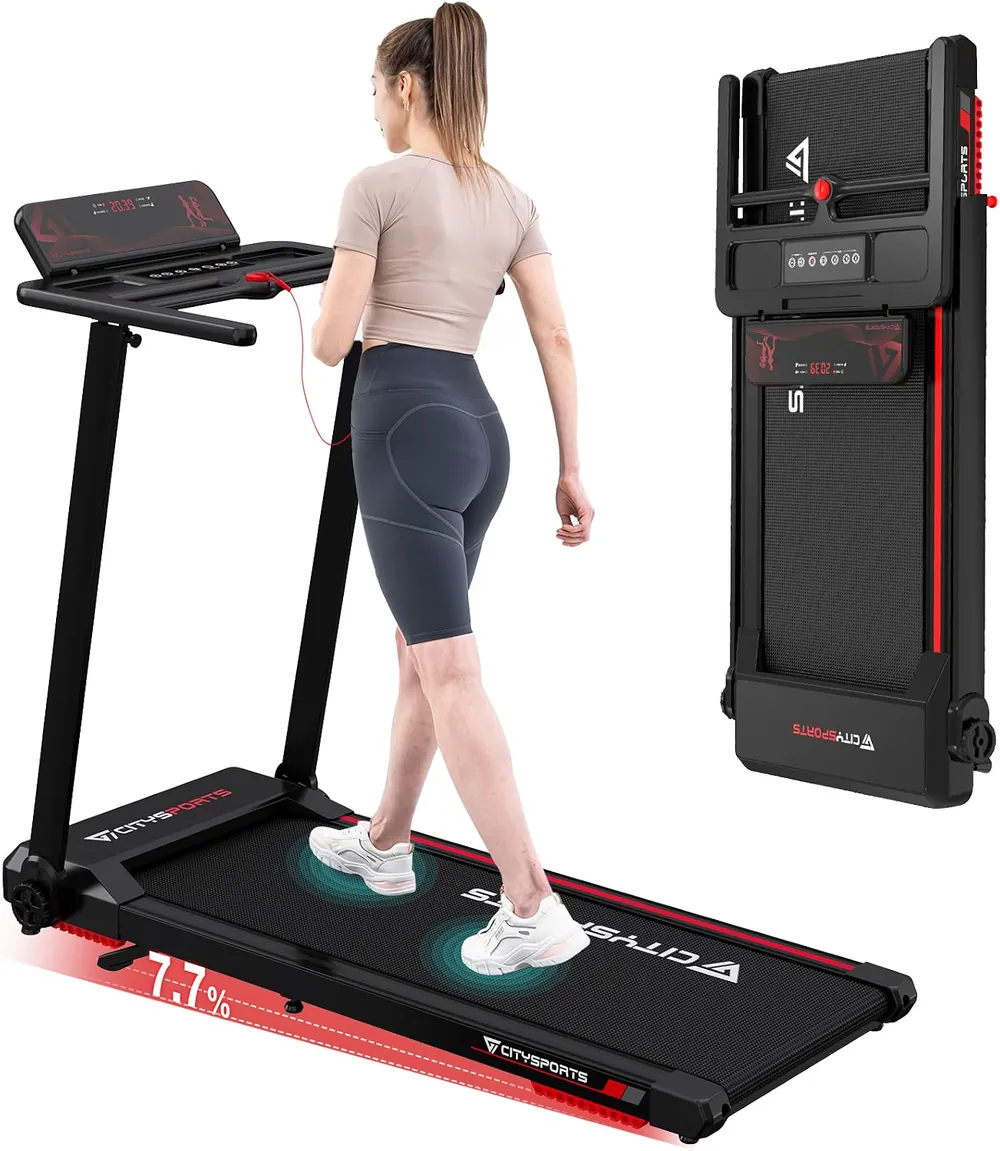
A quiet treadmill: walking and running in a flat without disturbing anyone
The motor is barely heard, the belt a little, your footsteps far more. Here is where treadmill noise comes from, what the decibels in product listings are worth, and the steps that keep the peace with the neighbours.
Contents
The question of noise almost always comes up after the purchase, with the first message from a neighbour. Yet it is much easier to deal with beforehand. A treadmill in a flat is not doomed to cause disturbance: you just need to understand where the noise comes from and how it travels through a building.
The three sources of noise
- The motor produces a hum that rises with speed. It is airborne noise, heard mainly in the room.
- The belt slides over the deck and runs around the rollers. A dry, misaligned or over-tight belt rubs and squeaks.
- Your footsteps strike the belt. These impacts are transmitted to the deck, then to the floor, then to the building’s structure. This is the noise the neighbours below hear most.
When walking, all three remain moderate. When running, impacts clearly dominate, because each stride includes a flight phase and a harder landing.
What the decibels in listings are worth
Product listings readily claim “silent” or a decibel figure. Yet a noise level only means something with two details: the speed at which it was measured and the distance of the microphone. A treadmill measured at 3 km/h from two metres is not comparable with one measured at 10 km/h from one metre.
To put figures in context, the scale published by the Quebec health authorities gives a few benchmarks:
| Level | Example |
|---|---|
| 20 dBA | Whisper heard from one metre |
| 30 dBA | Quiet conversation |
| 40 dBA | Refrigerator |
| 60 dBA | Normal conversation |
Remember too that the decibel scale is logarithmic: according to Brussels Environment, two sources of the same level add about 3 dB, not double the figure. Above all, none of these figures measures what the neighbour below perceives: vibrations transmitted through the floor do not show up on a listing.
Vibration, enemy number one
In a building, impact noise travels through the structure: slab, load-bearing walls, pipes. It spreads much further than airborne noise and is perceived as dull, repeated thuds, which are particularly irritating. A treadmill placed directly on a floating wooden floor or tiles transmits these thuds almost unfiltered.
The solution is to decouple the treadmill from the floor. You do not eliminate the impact, you stop it entering the structure.
The anti-vibration mat
This is the most effective and cheapest piece of equipment. Choose:
- Real thickness: a thin floor mat protects the floor but filters thuds poorly.
- A dense material, rubber or high-density foam, rather than soft foam that makes the treadmill unstable.
- A surface larger than the machine, so that the feet and deck rest entirely on it.
The mat has two side benefits: it protects your floor covering and reduces the dust drawn in by the motor.
Stride, speed and shoes
At the same speed, two people do not make the same noise. A few personal adjustments make a big difference:
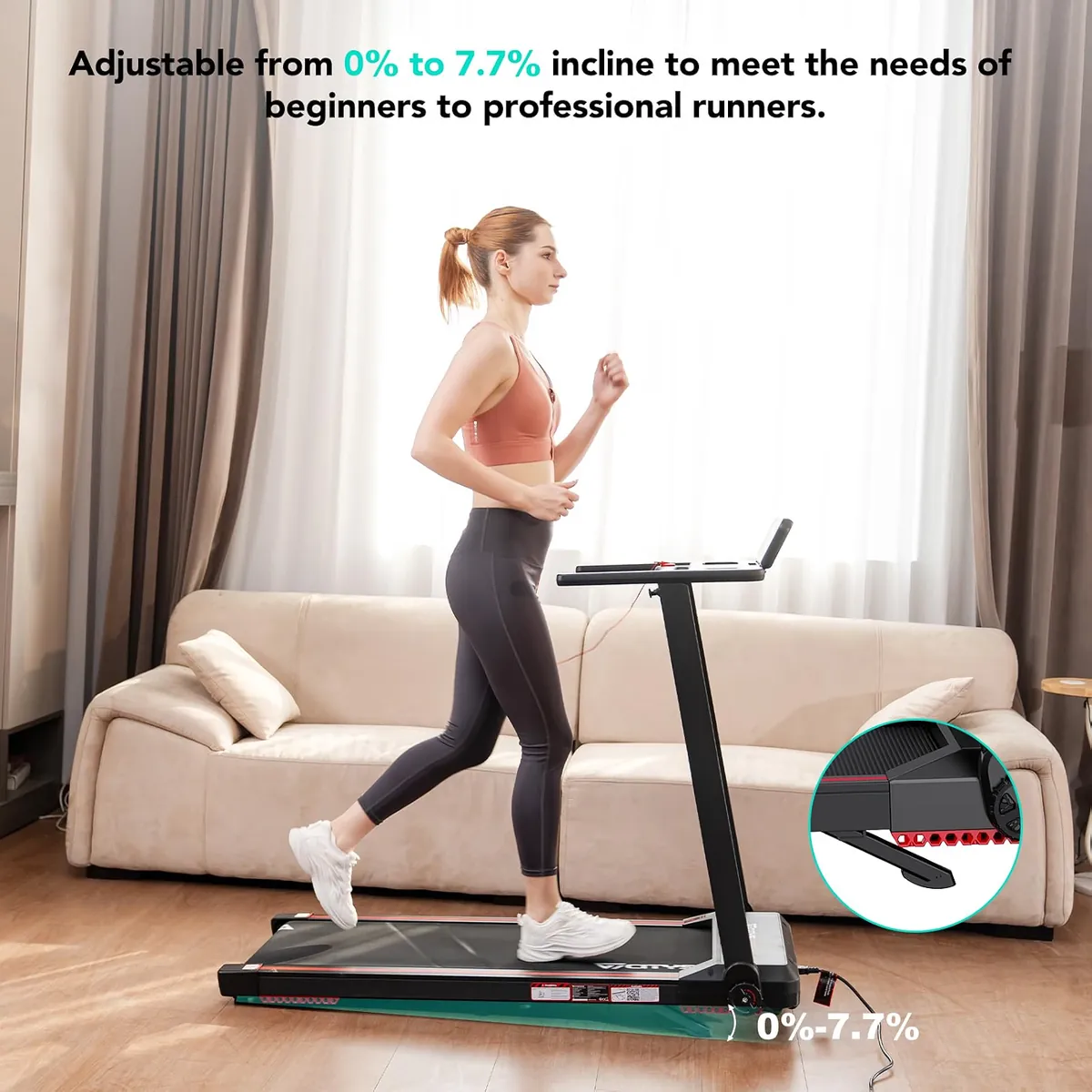
- Walk rather than run at sensitive times. Brisk uphill walking works your heart without extra impact.
- Lighten your stride: when running, shorter, quicker steps reduce the force of each landing.
- Avoid heavy heel strikes when walking briskly.
- Wear cushioned shoes kept for indoor use. Barefoot or in socks, you slip and the belt gets dirty.
- Stay in the middle of the belt: too close to the front, you risk hitting the motor cover.
A well-maintained treadmill is a quiet treadmill
A new squeak almost always signals a simple mechanical problem:
| Noise | Common cause | Solution |
|---|---|---|
| Continuous rubbing | Dry deck | Lubricate as the manual says |
| Rubbing on one side | Belt misaligned | Realign with the rear screws |
| Rhythmic knocking | Loose screw | Tighten the screws |
| Squeaking | Shoes on the belt, upright not properly locked | Try other shoes, check the lock |
| Motor straining | Belt too tight or too dry | Check tension and lubrication |
Our maintenance guide explains each adjustment.
Timing and good neighbourly relations
There is generally no single national timetable for exercising at home. Your lease, the building rules or the residents’ association may, however, set rules. Read them. Beyond the rules, a few habits avoid conflict:
- Keep running for times when the building is busy, and walking for quiet times.
- Avoid long, repeated sessions very early in the morning or late at night.
- Talk to your neighbours after the first sessions: ask them if they can hear anything. A conversation is better than a letter.
- Test it: ask someone to listen from the floor below while you walk and then jog.
What the rules say
Rules on domestic noise vary from country to country. In France, for example, article R1336-5 of the Public Health Code states that no particular noise may, by its duration, repetition or intensity, disturb the peace of the neighbourhood, day or night. In the UK, local councils can take action against noise from a home that amounts to a statutory nuisance, and your tenancy agreement or lease may contain its own clauses.
In practice, a treadmill is not forbidden in a flat. What can cause problems is repeated, long or intense noise that durably disturbs a neighbour. The steps above are enough in the vast majority of cases.
And the CITYSPORTS treadmill?
The CITYSPORTS treadmill’s Amazon listing mentions an “extremely silent” motor and a five-layer belt with a sound-absorbing coating, without giving a figure. One published comparison quotes 65 dB at 10 km/h and recommends an anti-vibration mat in a flat. One buyer review published on the brand’s website describes it as moderately noisy with a slight squeak.
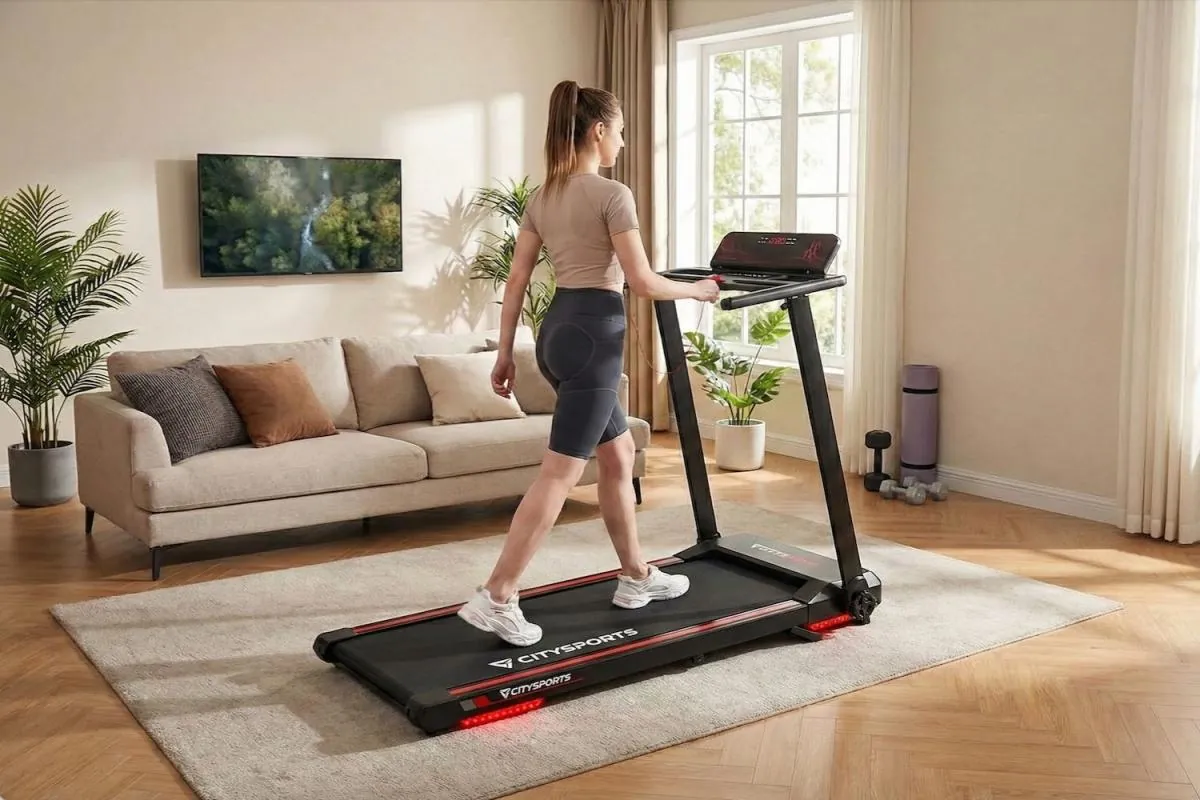
Our reading: when walking, with an anti-vibration mat, it suits a flat. When running, especially in the evening and upstairs, you will need to take the neighbours into account. Our full review details this point.
The anti-noise checklist
- A thick, dense anti-vibration mat, larger than the machine.
- The treadmill placed away from party walls if possible.
- Walking at quiet times, running at busy times.
- Cushioned shoes, a light stride.
- A lubricated deck, a centred and properly tensioned belt.
- Screws checked every month.
- A word with the neighbours below after the first sessions.
Your floor changes everything
Two flats, two identical treadmills, two opposite experiences: the difference often comes from the floor. Impact noise travels more or less depending on construction.
| Floor type | Behaviour | Advice |
|---|---|---|
| Thick concrete slab, screed and covering | Transmits less vibration | Standard anti-vibration mat, walking without worry |
| Floating wooden floor on thin underlay | Resonates, amplifies thuds | Thick, dense mat, well beyond the machine’s edges |
| Old timber floor on joists | Transmits strongly, may vibrate | Slow walking by preference, avoid running in the evening |
| Tiles bonded to a slab | Hard, transmits sharp thuds | Anti-vibration mat essential |
If you do not know your floor, a simple clue: if you can hear your neighbours walking at home, they will hear you too. Then place the treadmill above a little-used room in their home, a hallway or bathroom rather than a bedroom.
The test protocol for the first sessions
Before setting up your treadmill for good, carry out a methodical test:
- Set the treadmill on its mat, in the intended spot.
- Walk 5 minutes at 3 km/h, then 5 minutes at 5 km/h.
- Jog 2 minutes at 8 km/h, if you plan to run.
- Have someone listen in the next room, and ideally at the neighbour’s below if they agree.
- Change the spot if too much noise gets through, and repeat the test.
This test takes twenty minutes and avoids months of tension. It also lets you check, during the 14-day cancellation period, that the treadmill suits your home.
Ideas that do not work
- Stacking cushions or blankets under the treadmill: it becomes unstable, and the motor draws in fibres.
- Putting the treadmill on thick carpet: it hampers ventilation and collects dust, without really filtering thuds.
- Running barefoot “to make less noise”: you slip, you get hurt, and the impact is no smaller.
- Lubricating heavily to get rid of a noise: too much lubricant makes the belt slip and attracts dust. Follow the manual.
- Ignoring a squeak: it rarely fades away on its own.
House, ground floor, upper floor: three situations
In a detached house, noise only concerns your household. Place the treadmill away from bedrooms if you run early or late, and on a firm floor.
On a ground floor, on a slab, vibration travels mainly through the party walls. Move the treadmill a few tens of centimetres away from those walls and place it on an anti-vibration mat.
On an upper floor, the most sensitive situation, combine all the solutions: a dense mat, a spot above a little-used room at the neighbour’s, walking at quiet times, running at busy times, and a word with the neighbours. This is where uphill walking comes into its own: it works your heart without the impacts of running.
Walk in the evening, run at the weekend
The simplest way to reconcile a treadmill with the neighbours lies in how you organise your week. Keep the noisy sessions, running and intervals, for times when the building is lively: late morning, weekend afternoons. Keep walking, flat or uphill, for the quiet hours of the morning and evening.
This split has another advantage: it often matches a good training balance, with plenty of walking and a little running. Our workout plans follow this logic. And if your schedule only leaves you the evening, brisk uphill walking will let you progress with almost no impact noise.
Sparing the motor also reduces noise
A motor that strains is a motor that makes noise. Three situations make it strain: a belt that is too tight, a dry deck, a load close to the maximum. The first two are fixed by maintenance. The third is avoided at the time of purchase, by choosing a treadmill whose maximum load is well above your weight. For the CITYSPORTS, use 110 kg, the lowest published value. A motor that works comfortably stays quiet for longer.
Sharing walls: flats, houses in multiple occupation
When you share a home or live in a converted house, the people disturbed by your treadmill may be on the other side of a thin partition rather than below you. Airborne noise then matters more than usual: the motor hum, the belt and music from the speaker. Place the treadmill against an outside wall rather than a shared one, keep the speaker volume low or use headphones, and agree on times with your housemates. A short message in a shared group chat before an evening session is often enough to avoid tension.
Frequently asked questions
Is a treadmill noisier than an exercise bike?
When running, yes, because of the impacts. When walking, the gap narrows considerably.
Is the anti-vibration mat enough?
It greatly reduces vibration, but does not eliminate the impacts of fast running. Combine it with walking at quiet times.
Can you run in the evening in a flat?
It is not forbidden, but repeated or intense noise that disturbs a neighbour can be a problem, day or night. Prefer walking in the evening.
Why does my treadmill squeak?
Most often: a dry deck, a misaligned belt, a loose screw or shoes rubbing. Check in that order.
Is the CITYSPORTS quiet?
The manufacturer publishes no figure. One comparison quotes 65 dB at 10 km/h. When walking, it remains discreet.
Where should I put the treadmill in the flat?
On a firm floor, away from party walls if possible, and preferably above a little-used room at the neighbour’s below.
Should I warn my neighbours before installing a treadmill?
It is not compulsory, but it often helps. Asking them if they hear anything after the first sessions lets you adjust the spot before irritation sets in.
Is a foam floor mat enough?
Thin foam protects the floor but filters thuds poorly. Prefer a dense, thick material larger than the machine.
Does uphill walking make noise?
Very little: speed stays low and there is no flight phase as in running. It is a good option for evening sessions.
Can treadmill noise travel through the walls?
Yes, especially on the ground floor and along party walls. Move the treadmill a few tens of centimetres away from those walls.
Should certain speeds be avoided?
Upstairs and at quiet times, stick to walking. Running at 9 km/h and above produces far more impacts.
Do shoes change the noise?
Yes. Cushioned shoes and a light stride reduce thuds; soles that rub can also squeak on the belt.
Is it better to use headphones than the built-in speaker?
In a shared home or late in the evening, yes: headphones remove one source of noise completely.
Your next kilometre starts here.
12 km/h · 1400 W · 400 x 1020 mm belt · Bluetooth · No assembly. The price changes often on Amazon: check it, along with the seller and the stated maximum load, before ordering.
Check the price on AmazonAffiliate link · new tab