How to choose a folding treadmill: the complete guide
Speed, motor, belt, incline, maximum load, folding, noise, safety: the criteria that really matter when choosing a folding treadmill, and the ones product listings wrongly put first.
Contents
Choosing a folding treadmill looks like an exercise in comparing figures: kilometres per hour, watts, millimetres, kilos. Yet two treadmills with almost identical listings can give very different experiences. This guide helps you read those figures, spot the ones that are missing and, above all, link them to what you will actually do on your treadmill. We use our reference model, the CITYSPORTS 12 km/h treadmill, as an example, without making it a universal answer.
Start from your use
The first question is not “which treadmill?” but “what for?”. Four uses cover most home purchases:
| Main use | Typical frequency | Priorities |
|---|---|---|
| Walking while working | Several breaks a day | Steady slow speed, quietness, low height |
| Walking for fitness | 3 to 6 sessions of 20 to 60 min | Belt width, incline, comfort |
| Walking and jogging | 3 to 4 sessions, 1 or 2 of them running | Speed of 10 to 12 km/h, belt length, motor |
| Running regularly | Runs of 30 min or more | Long belt, continuous-rated motor, cushioning, sturdiness |
Be honest with yourself. Many buyers imagine they will run and end up walking, which is absolutely fine, but makes a heavy, bulky treadmill pointless. Conversely, a regular runner who buys a walking pad to save space will soon be frustrated.
The families of folding treadmill
The walking pad
A very flat board, often without uprights, sometimes with a remote control. Speed usually tops out at around 6 km/h. It slides under a sofa and fits under a standing desk. It is a walking machine, not a running one.
The compact treadmill with a folding handrail
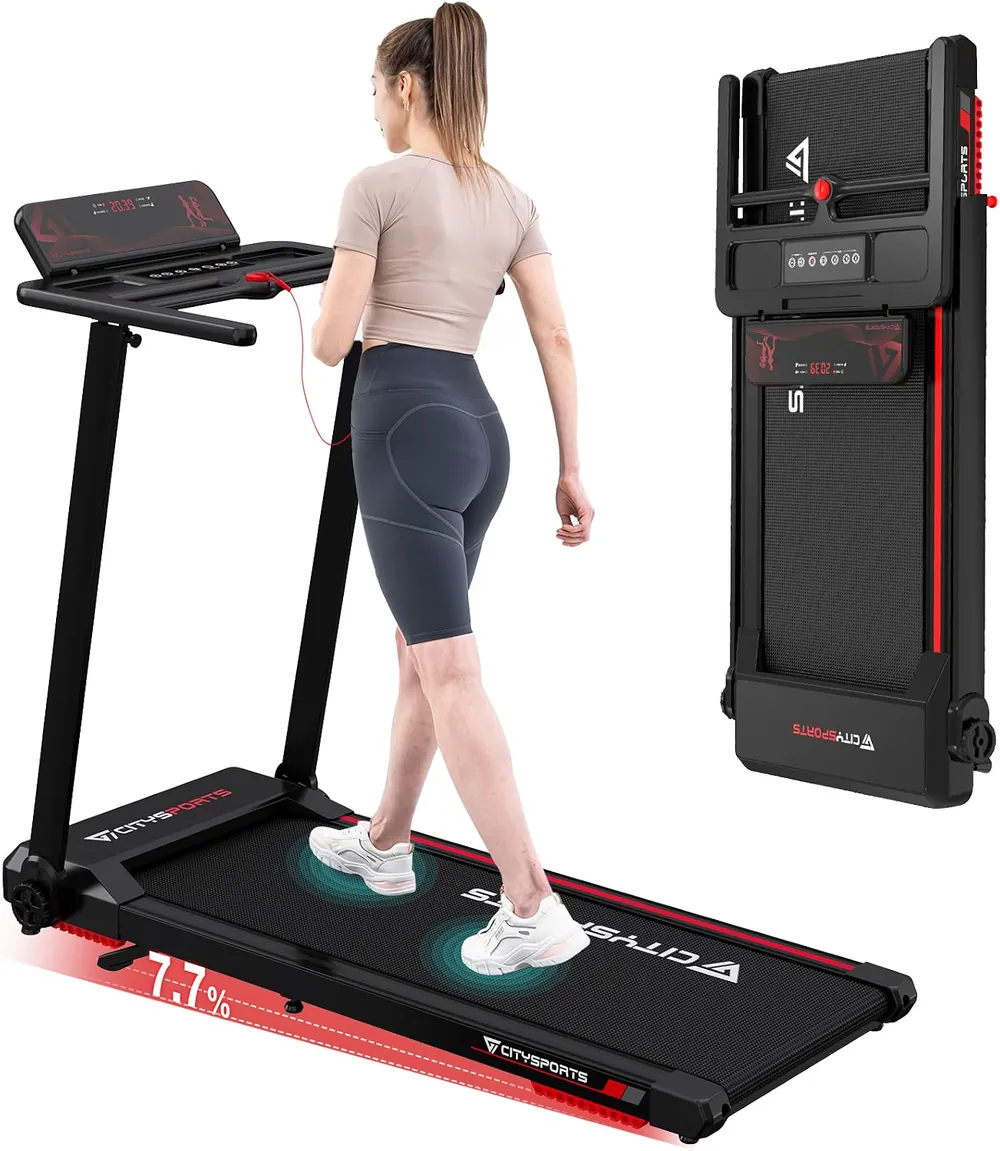
A low deck with two uprights carrying the console. Raised, they serve as support; lowered, they fold down onto the deck. These treadmills often reach 10 or 12 km/h. Our reference model belongs to this family.
The lift-up deck treadmill
A larger treadmill whose belt lifts up vertically against the console, often with a gas strut. It offers a longer belt, a sturdier motor and sometimes a motorised incline, but remains bulky even when folded.
The 2-in-1 treadmill
Some models work as a walking pad with the uprights down, at a limited speed, and as a running treadmill with the uprights raised, at a higher speed. Read the listing carefully to know which speed is available in which position.
Speed: what you really need
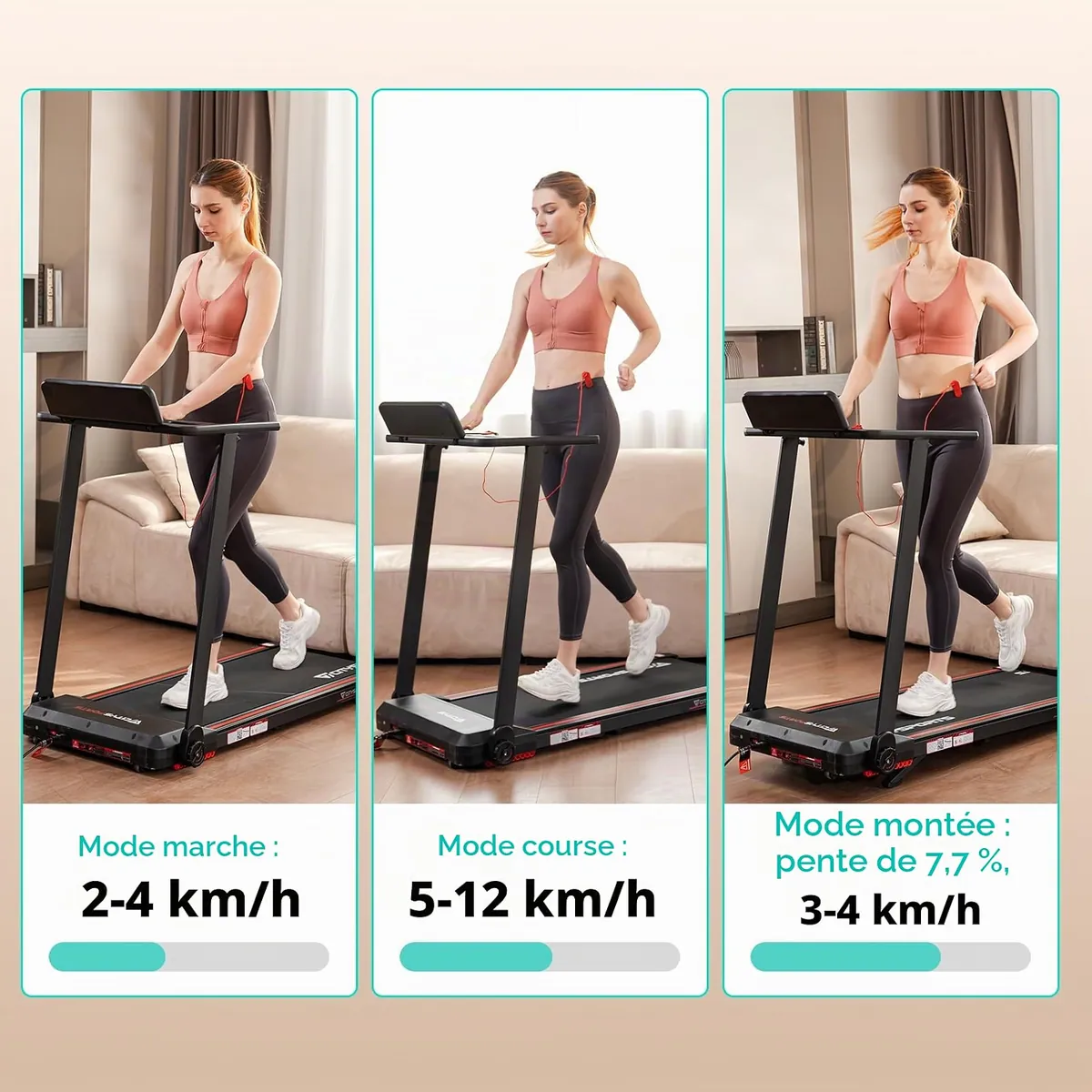
An adult’s usual walking speed is between 4 and 6 km/h. Above 7 to 8 km/h, most people naturally break into a run. Here are the useful benchmarks:
| Speed | Pace | What it allows |
|---|---|---|
| 1 to 3 km/h | Very slow walking | Walking while typing |
| 4 to 6 km/h | Active to brisk walking | Walking session, moderate activity |
| 8 km/h | 7 min 30 per km | Slow jog |
| 10 km/h | 6 min per km | Jogging |
| 12 km/h | 5 min per km | Steady running, bursts of pace |
For walking, 6 km/h is enough. For jogging, aim for at least 10 km/h, and 12 km/h if you want room for faster bursts. A runner whose usual runs are at 12 km/h will need a treadmill that goes higher, so as not to spend the session at the machine’s top speed.
The motor: reading watts and HP
Motor power is often the most prominent figure, and the most misunderstood. Two notions coexist:
- Peak (or maximum) power: what the motor can deliver briefly.
- Continuous power: what it can sustain over time without overheating.
Listings for compact treadmills most often give peak power. A motor rated at 1400 W or 1.88 HP peak, like the CITYSPORTS’s, handles walking and jogging without difficulty. To compare two treadmills, compare powers of the same kind: a continuous power of 1.5 HP is not “weaker” than a peak power of 2.5 HP, it measures something else.
The motor works harder when you are heavy, when you run fast and when the belt is poorly maintained. A belt that is too tight or a dry deck increase friction and strain the motor: maintenance matters as much as the listing.
The running belt: width and length
The belt is the surface you walk on. Its two dimensions play different roles:
- Width determines your sideways freedom. At around 40 cm, you place your feet naturally without watching where they land. Below that, more attention is needed, especially when walking while reading or phoning.
- Length determines the possible stride. It matters little when walking, a lot when running: the faster you run, the longer your step.
The CITYSPORTS belt measures 400 x 1020 mm. That is comfortable for walking and enough for jogging, but short for a long stride at 11 or 12 km/h. Large treadmills for regular runners often exceed 130 cm. If you are tall and a runner, belt length is your number one criterion.
Cushioning: promise and reality
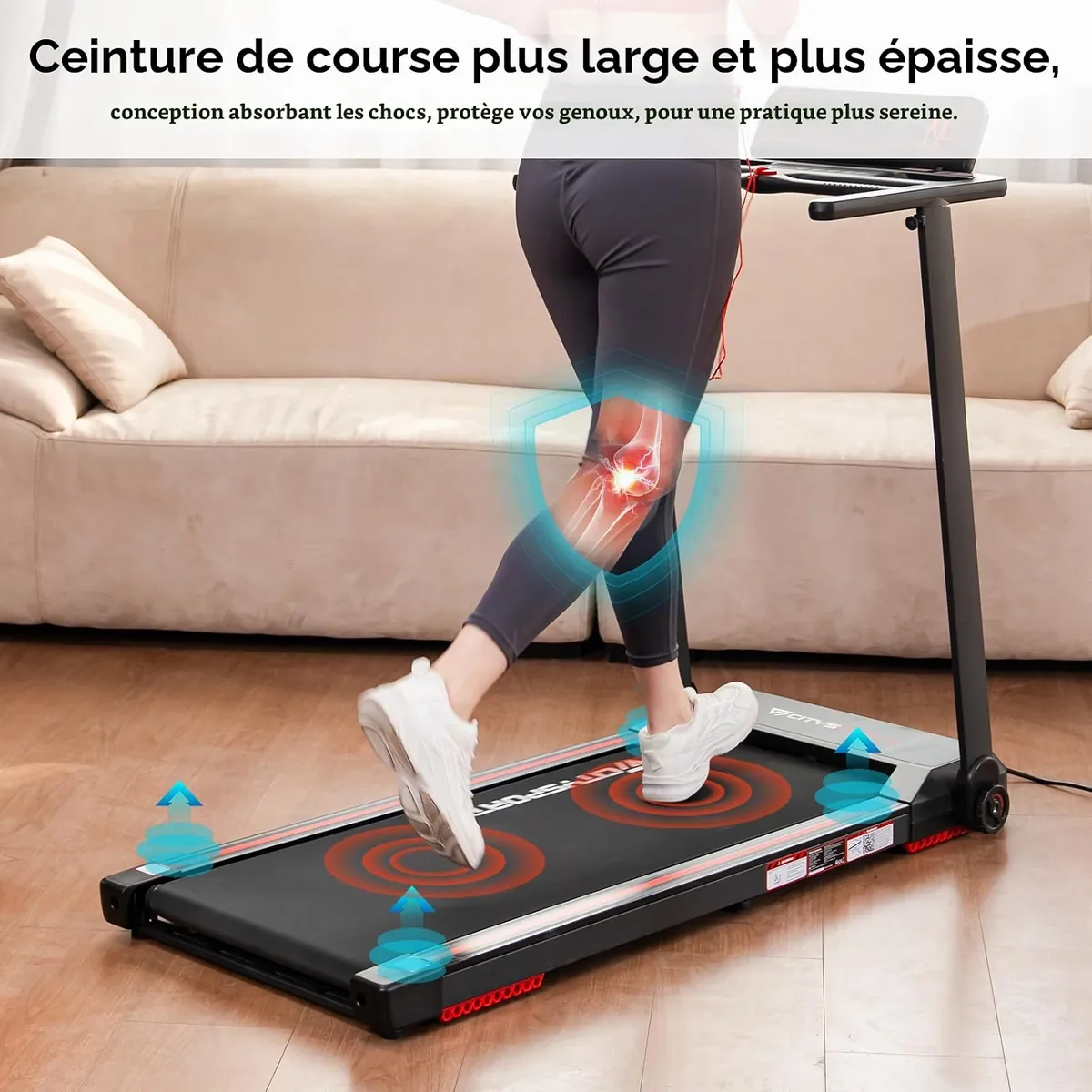
Almost every listing promises cushioning that “protects the joints”. On a compact treadmill, cushioning comes mainly from the belt itself (thickness, number of layers) and a few rubber mounts under the deck. Large gym treadmills use more elaborate suspension systems.
No simple standard lets you compare the cushioning of two treadmills from their listings. Remember three benchmarks: a multi-layer belt is better than a thin one; your shoes remain your first shock absorber; and walking, even briskly, puts far less stress on the body than running. If you have joint pain, uphill walking is often a better route than running on the flat.
Incline: manual or motorised
An incline makes walking harder without increasing speed or impact. It is an excellent tool for progressing when you do not want to run. Two systems exist:
| Type | How it works | Advantages | Limitations |
|---|---|---|---|
| Manual | Feet or notches set when stopped | Simple, no extra motor | One or a few positions, no change mid-session |
| Motorised | Set from the console | Hill programmes, changes mid-session | Heavier, more expensive treadmill, one more part to maintain |
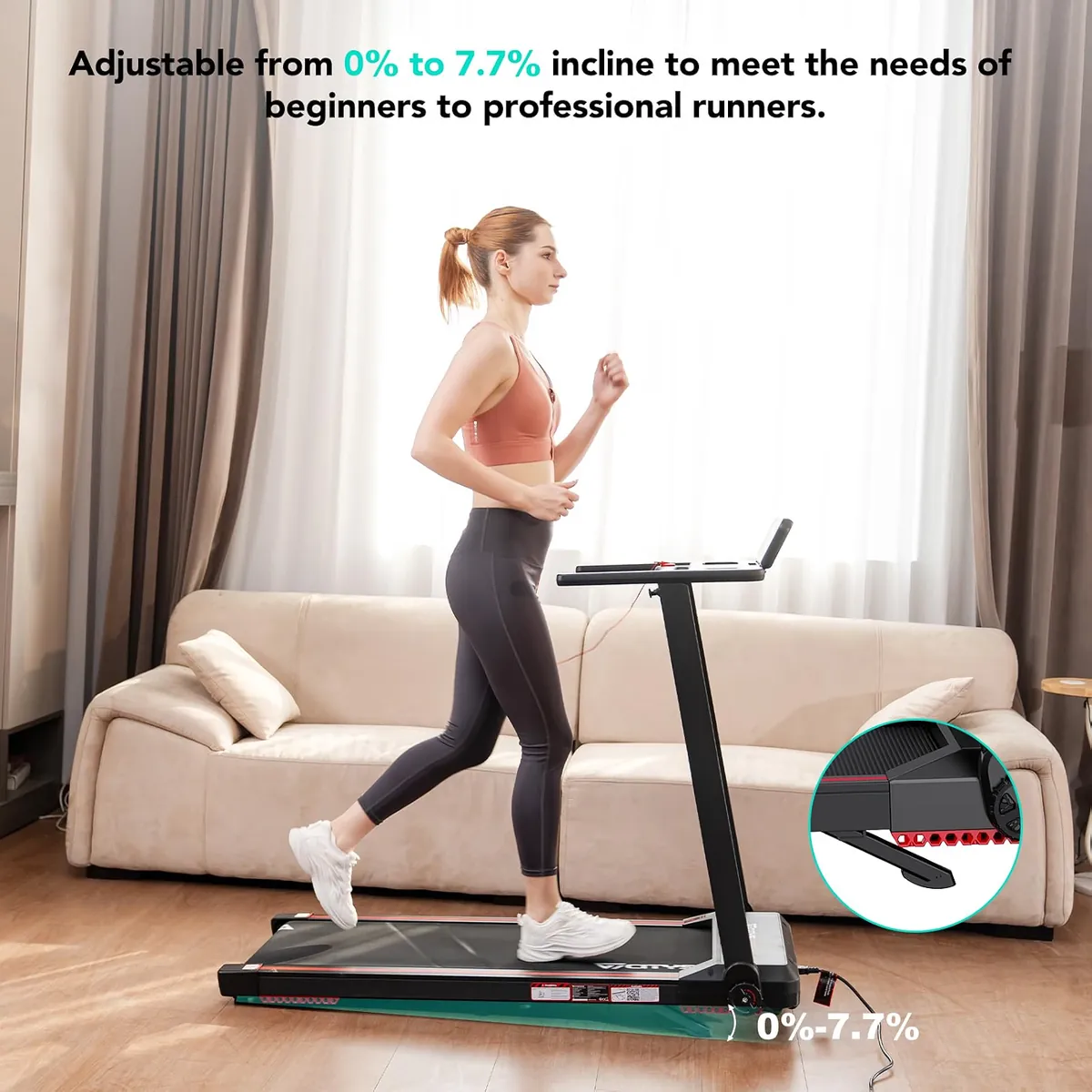
The CITYSPORTS offers a manual incline of up to 7.7 %. Always check the type of incline on the listing: buyers of a similar model regret that its manual nature is not stated in the listing. For running, a study by Jones and Doust (1996) showed that a 1 % gradient best reproduces the energy cost of running outdoors.
Maximum load
The maximum load is the user weight the manufacturer allows. It must exceed your weight with a margin, for two reasons: when running, each stride transmits a force to the treadmill well above body weight at rest; and a motor working close to its limit wears out faster.
Read the listing carefully: two values sometimes coexist. On the CITYSPORTS Amazon page, the description states 120 kg and the technical table 110 kg. In that case, use the lower one. A margin of 15 to 20 kg below the maximum load is a common-sense benchmark, especially if you plan to run.
Folding, weight and storage
A folding treadmill is only useful if it really fits where you imagine storing it. Before buying:
- Measure the storage spot: length, width and above all the height under a bed or sofa.
- Look for the folded size on the listing, not just the unfolded dimensions.
- Check the weight: above 25 to 30 kg, you roll the treadmill rather than carry it.
- Check the wheels: without them, a 26 kg treadmill becomes a chore to move every day.
- Think about storing it upright: practical, but it needs secure support to prevent any tipping.
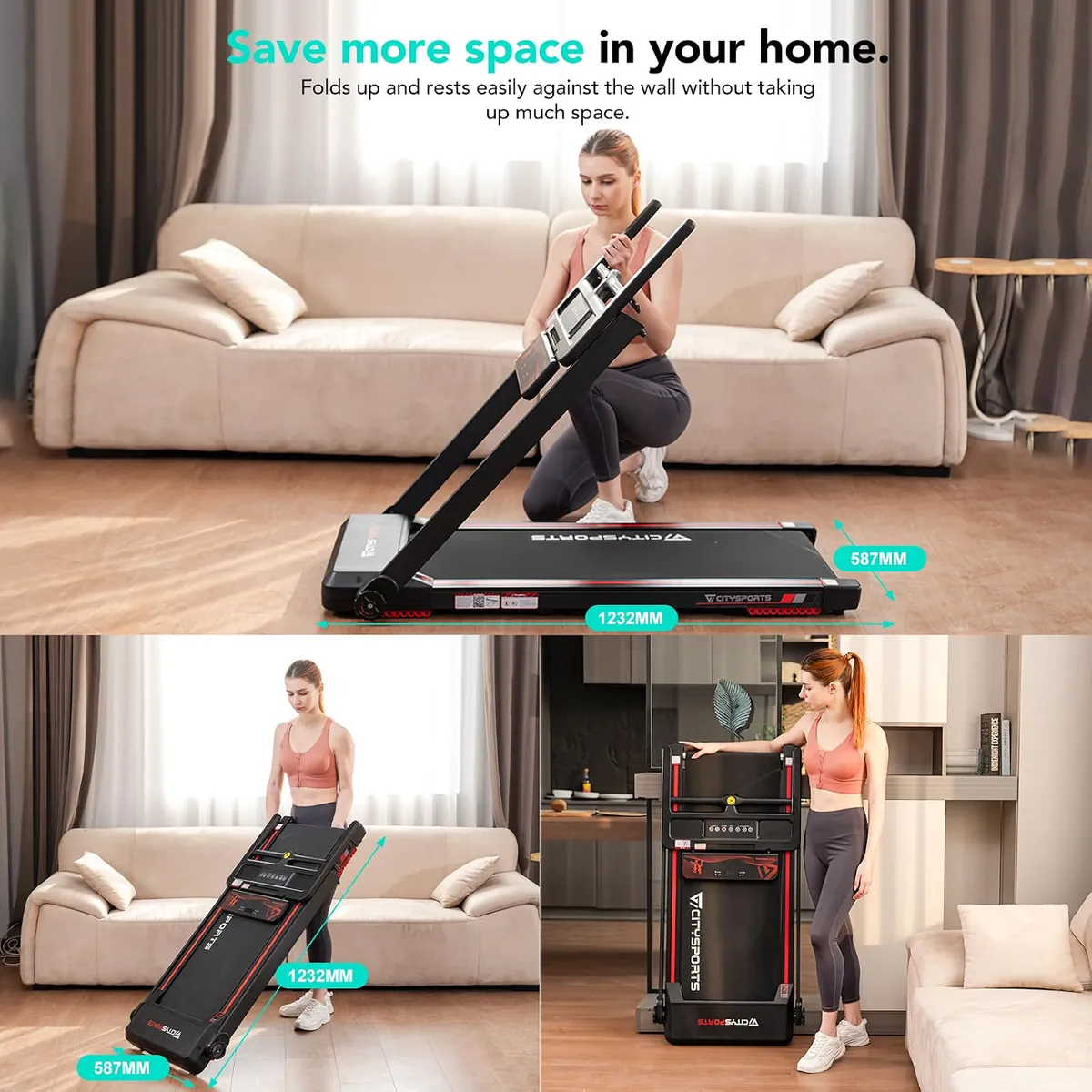
The CITYSPORTS weighs 26.5 kg, has front wheels and takes up about 1232 x 587 mm of floor once folded according to the manufacturer’s images. Its folded thickness is not published.
Noise
A treadmill makes three noises: the motor, the belt rubbing on the deck and the impact of footsteps. The first two depend on the machine and its maintenance. The third depends on your stride, your shoes and the floor. It is often what disturbs the neighbours below, in the form of dull thuds.
Be wary of decibel figures without context: a noise level only means something if you know the speed and the measuring distance. The CITYSPORTS Amazon listing gives no figure; one comparison quotes 65 dB at 10 km/h. Our article a quiet treadmill in a flat explains how to reduce each source of noise.
Safety equipment
Three pieces of equipment are essential:
- The safety key, attached to your clothing by a cord, which stops the belt if you move away. When removed, it prevents starting.
- A stop button within easy reach.
- A gradual start at slow speed.
A handrail is a plus, especially for people getting back into exercise or with fragile balance. On a walking pad without uprights, safety relies entirely on your attention and the remote control. Our guide treadmill safety details the precautions, children included.
Console, programmes and shortcuts
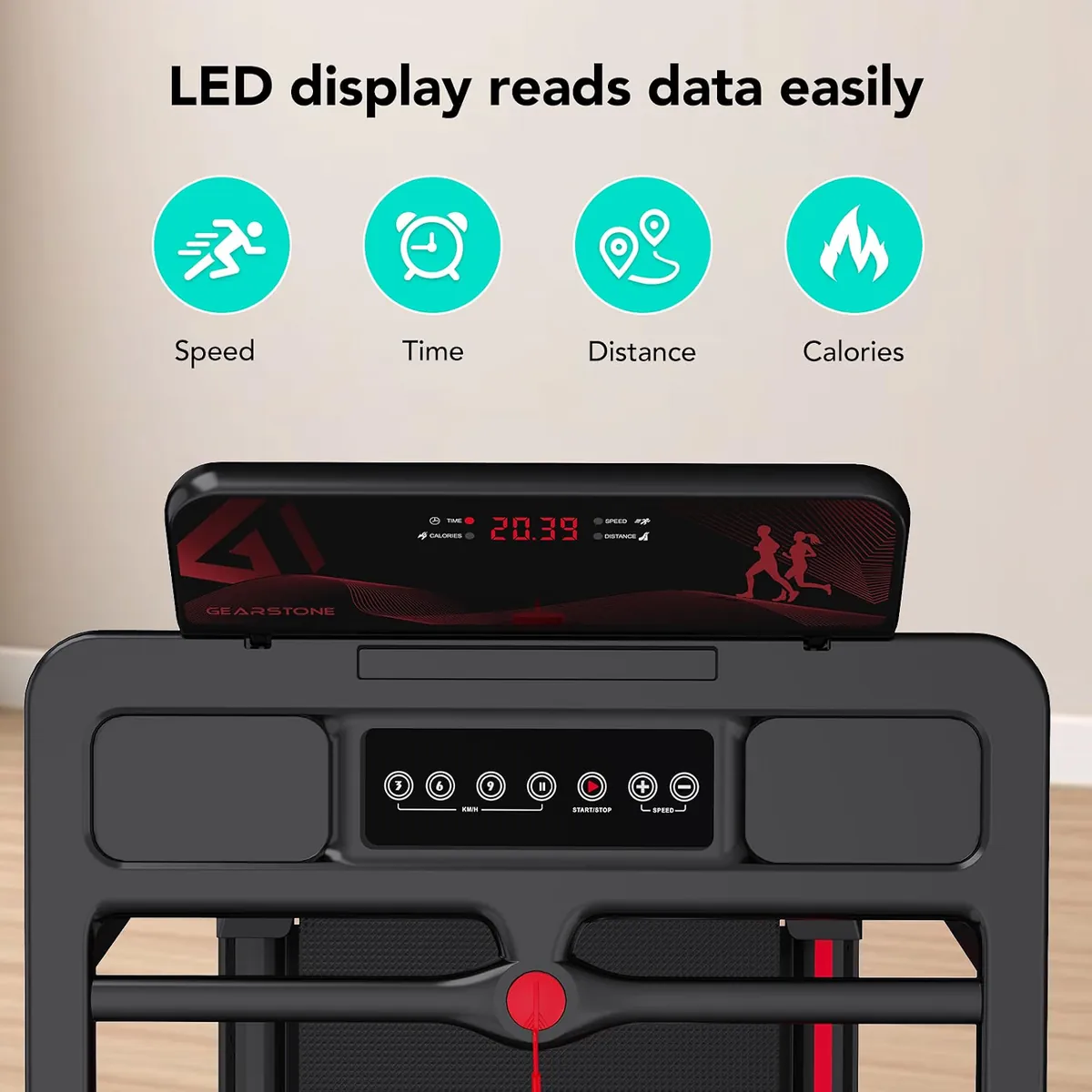
A basic console shows time, speed, distance and calories. That is enough for most uses. More useful than a big screen are speed shortcuts, which save you pressing “+” twenty times. The CITYSPORTS offers shortcuts at 3, 6 and 9 km/h.
Built-in programmes (12 on our reference model according to the listing) vary the speed automatically. They can help break the monotony, provided you know what they do: an automatic acceleration to 10 km/h is a surprise when you do not expect it. The calories shown remain general estimates.
Apps and Bluetooth
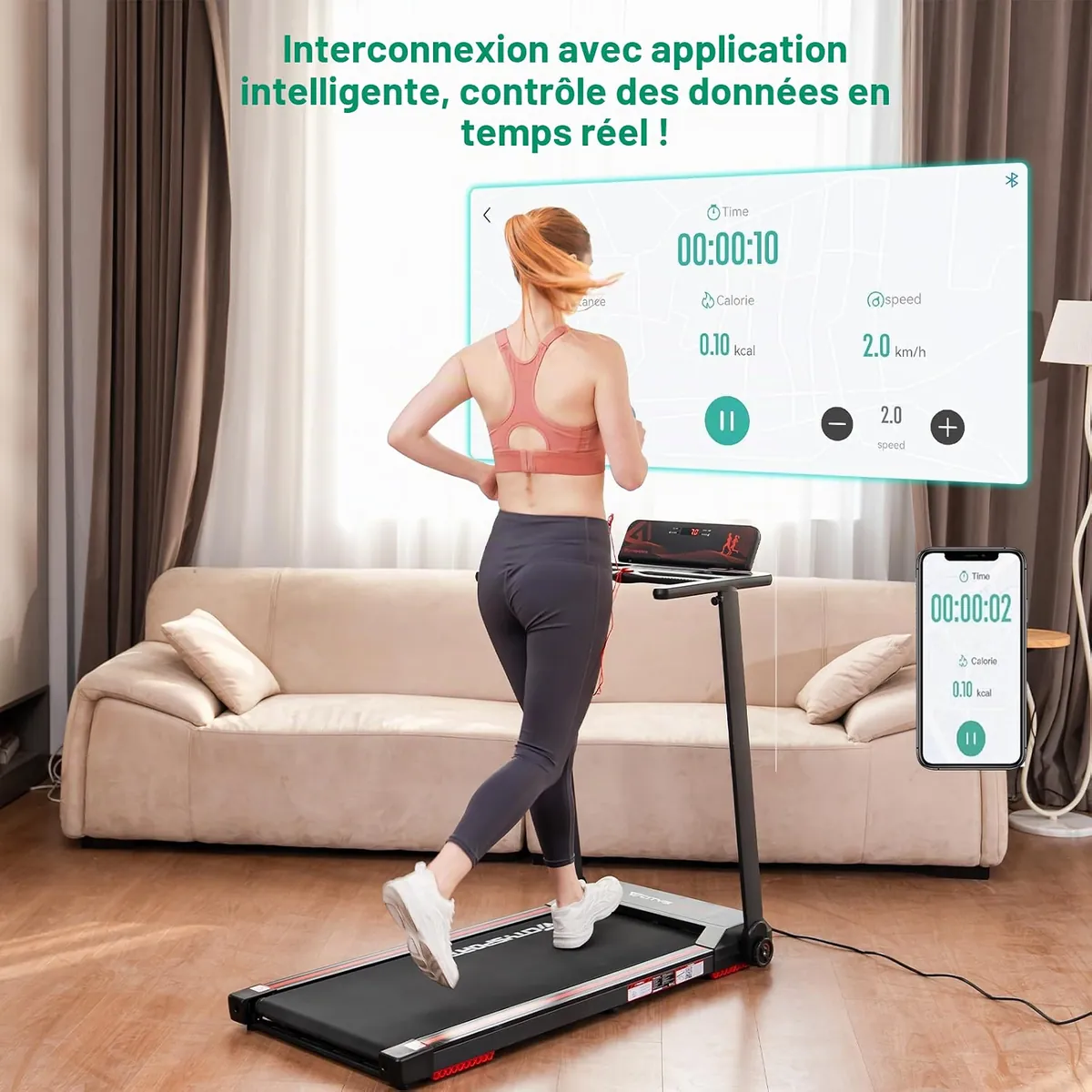
“Bluetooth” covers different realities: a built-in speaker, an in-house app that displays your data, or real compatibility with platforms such as Kinomap or Zwift. If a particular app matters to you, check that your exact model is on its compatibility list before buying.
The CITYSPORTS offers a Bluetooth app, whose name is given neither on Amazon nor on the manufacturer’s website, and a built-in speaker. No compatibility with the major platforms is announced. A tablet holder, here swivelling 360°, is often more useful day to day than an app: it lets you follow a series, a class or a video route.
Electricity and consumption
A treadmill is an electrical appliance that starts under load. Two simple rules:
- Plug it directly into a wall socket. Most manuals advise against extension leads and power strips.
- Unplug it after use, for children’s safety and to avoid standby.
The motor’s peak power does not tell you how much the treadmill actually consumes: consumption depends on your weight, speed and duration. For a walking session, it remains modest compared with a heater.
Seller, manual and after-sales service
On a marketplace, the seller matters as much as the product. They handle returns, warranty and parts. Before buying, check:
- who sells and who ships;
- whether a manual in your language is available;
- whether a commercial warranty is offered on top of your statutory rights;
- whether you can get a replacement safety key or lubricant.
In the UK, when you buy online from a business, you have 14 days to cancel under the Consumer Contracts Regulations, and the Consumer Rights Act protects you against faulty goods. The CITYSPORTS brand website mentions a one-year commercial warranty.
The traps in product listings
- Power without detail: peak or continuous? Often, nothing says.
- “Silent” without a figure, or a figure without a measuring speed.
- Two maximum loads on the same page.
- An incline without detail: manual or motorised?
- Unfolded dimensions only, without the folded size.
- Almost identical model names for different treadmills: check top speed and belt size.
- A “Bluetooth” that sometimes only means a speaker.
- Lifestyle photos showing someone running fast on a compact treadmill: the photo tells you nothing about belt length.
The pre-purchase checklist
- I have defined my main use: walking, walking and jogging, or running.
- The top speed matches that use, with a margin.
- The belt is wide enough for walking and long enough if I run.
- The lowest published maximum load exceeds my weight with a margin.
- I have measured the space for use, the clearance behind and the storage spot.
- The treadmill has a safety key and an accessible stop button.
- I have planned an anti-vibration mat if I live upstairs.
- I have checked the seller, the manual and my rights.
Our pick
For the most common use, walking often and jogging sometimes in a home without a dedicated room, we recommend the CITYSPORTS folding treadmill: 1 to 12 km/h, 3-6-9 shortcuts, a 400 x 1020 mm belt, a 7.7 % manual incline, 26.5 kg on wheels, no assembly. Its limitations are known: incline set when stopped, short belt for fast running, maximum load best taken as 110 kg. Our detailed verdict helps you check that it suits you.
Five profiles, five treadmills
The sedentary home worker
They want to break up sitting time, as Anses recommends: 3 to 5 minutes of walking every 30 minutes, plus walking during calls. They need a low, steady minimum speed, quiet operation and a machine compatible with a height-adjustable desk. A walking pad is enough; a hybrid treadmill with a folding handrail also lets them do proper sessions in the evening.
The person getting back into exercise
They start by walking and need confidence and support. The handrail, the safety key and a slow start matter more than top speed. An incline, even a manual one, will let them progress without running.
The regular walker
They walk 30 to 60 minutes, four to six times a week, often in front of a series. Their priorities: a belt wide enough to walk without watching their feet, an incline for variety, a tablet holder. Top speed matters little.
The occasional runner
They walk during the week and jog at the weekend, at 8 or 10 km/h. They need a treadmill that reaches at least 10 km/h, ideally 12, and a belt at least a metre long. This is the typical CITYSPORTS profile.
The regular runner
They run several times a week, sometimes above 10 km/h, for 30 minutes or more. They need a long belt, a motor with a published continuous rating, good cushioning and a high maximum load. A compact treadmill will be a back-up machine for them; a larger treadmill, even if it takes up more room, will be more suitable.
Compact or large treadmill: the table
| Criterion | Compact folding treadmill | Large lift-up deck treadmill |
|---|---|---|
| Folded size | Small, stored flat or upright | Large, even when folded |
| Weight | Often 20 to 30 kg | Often much heavier |
| Belt length | Around one metre | Often 130 cm and more |
| Speed | Often 6 to 12 km/h | Often 16 km/h and more |
| Incline | None or manual | Often motorised |
| Ideal use | Walking, jogging, small homes | Regular running, dedicated room |
| Installation | Often no assembly | Assembly often required |
These ranges are indicative and vary by brand. They show the essential point: the compact treadmill trades a little running capacity for a lot of space saved.
New or second-hand?
A second-hand treadmill can be a good deal, provided you check it in person. Points to check:
- The belt: no frayed edges, no shiny or cracked area in the middle.
- Operation: run it at several speeds, step on it, listen. No rubbing, no jolts, no burning smell.
- The safety key: it must be supplied and work.
- The manual: ask for it, or find it online with the exact model reference.
- Folding: joints without play, a firm lock.
Bear in mind that a private sale does not give you the same statutory protection as buying from a business. A new treadmill bought online from a business gives you a 14-day cancellation period and protection against faulty goods.
Questions to ask the seller
On Amazon and marketplaces, the questions section often clears up a doubt before you buy. The most useful questions:
- Is the stated power peak or continuous?
- How thick is the treadmill once folded?
- Is the incline manual or motorised, and how many positions does it offer?
- What is the exact maximum load, if the listing gives two?
- Which lubricant should be used, and how often?
- What is the app called, and which phones does it work with?
- Is a replacement safety key available?
A clear, quick answer is also a clue to the quality of the after-sales service.
The most common buying mistakes
- Buying for the person you would like to be: a big runner’s treadmill for someone who will mostly walk. The machine takes up room and ends up as a clothes horse.
- Forgetting to measure the storage spot: the folding treadmill does not fit under the planned bed and stays in the middle of the living room.
- Ignoring the maximum load, or using the higher one when the listing gives two.
- Believing in “silent” without thinking of the neighbours below or the anti-vibration mat.
- Confusing manual and motorised incline, then being disappointed you cannot vary it mid-session.
- Choosing on power alone, without knowing whether it is continuous or peak.
- Neglecting the seller: on a marketplace, they handle returns and the warranty.
- Buying without a plan: the best treadmill is useless without regular sessions. Our beginner plans help you start from delivery day.
Each of these mistakes can be avoided with ten minutes of thought before buying. It is the best investment you will make in your future treadmill.
Matching the treadmill to your week
A good way to test your choice is to write down a realistic week before buying. How many sessions? At what time of day? Walking, uphill walking or jogging? Who else will use the machine? This simple exercise often reveals that the need is different from the one imagined in the shop.
| Your realistic week | What it implies |
|---|---|
| Short walks most days, several at the desk | Low minimum speed, quiet operation, easy controls |
| Three 40-minute brisk walks | Comfortable belt width, incline, tablet holder |
| Two walks and one 30-minute jog | At least 10 km/h, belt around one metre or more |
| Four runs, some above 10 km/h | Long belt, continuous-rated motor, high maximum load |
If your realistic week fits the first three rows, a compact folding treadmill is usually the right family. If it fits the last one, accept the extra footprint of a larger machine: you will use it more and it will last longer.
Sharing a treadmill at home
When several people use the same treadmill, the choice must work for the most demanding user. The heaviest person determines the margin needed below the maximum load. The tallest runner determines the belt length. The youngest members of the household determine the safety rules: key removed after each session, treadmill unplugged, children kept away during use.
Agree on simple habits: whoever finishes wipes the console, removes the key and folds the treadmill if needed. Note in a shared log when the deck was last lubricated. These small rules avoid most of the wear and disputes that come with shared equipment.
Frequently asked questions
What is the most important criterion?
Your use. It determines the useful speed, belt size and type of treadmill. Then come maximum load and folded size.
Is a 12 km/h treadmill enough for running?
For jogging and bursts of pace, yes. If you usually run at 12 km/h, choose a treadmill that goes higher, with a longer belt.
What belt width for walking?
At around 40 cm, you place your feet naturally. A narrower belt requires more attention.
Should I prefer a motorised incline?
If you want to vary the gradient during the session or follow hill programmes, yes. For walking uphill now and then, a manual incline is enough.
How do I read a motor’s power?
Check whether it is peak or continuous power, and compare values of the same kind. Continuous power is the most meaningful for running.
Can a walking pad replace a treadmill?
For walking, yes. For running, no: most top out at around 6 km/h. See walking pad or treadmill.
What margin should I keep below the maximum load?
A margin of 15 to 20 kg is a common-sense benchmark, more if you run. Use the lower value if the listing gives two.
Is an anti-vibration mat necessary?
Upstairs, yes: it limits the vibrations transmitted to the floor, protects the floor covering and reduces the dust drawn in by the motor.
Is a second-hand treadmill a good idea?
Yes if you can test it in person: belt, noise, folding, safety key. A private sale does not give you the same statutory protection as buying from a business.
Do I need a treadmill with built-in programmes?
It is not essential. Speed shortcuts and a simple session plan are enough for most users.
How much space do I need to use a folding treadmill?
The machine’s footprint, plus about two metres of clear space behind the belt and half a metre on each side, according to many manuals.
Is Bluetooth useful?
For listening to music on the speaker or tracking your sessions in an app, yes. For Kinomap or Zwift, check that your exact model is compatible.
Should I prefer a well-known brand?
What matters most is an identifiable seller, a manual in your language and reachable after-sales service, whatever the brand.
Can two people of different heights share a folding treadmill?
Yes, a treadmill needs no height adjustment. Check that the belt length suits the taller runner and that the maximum load leaves a margin for the heavier user.
Does a heavier treadmill mean a better treadmill?
Not necessarily. Weight often reflects a sturdier frame and bigger motor, but for walking and jogging at home, a light compact treadmill can be entirely suitable.
Your next kilometre starts here.
12 km/h · 1400 W · 400 x 1020 mm belt · Bluetooth · No assembly. The price changes often on Amazon: check it, along with the seller and the stated maximum load, before ordering.
Check the price on AmazonAffiliate link · new tab