Treadmill safety: the rules that prevent accidents
A treadmill is a simple machine, but its moving belt can injure an inattentive adult, a curious child or a pet. Here are the rules that are enough to avoid most accidents at home.
Contents
Safety is rarely on your mind when you buy a treadmill. Yet a few simple rules make all the difference. They need neither equipment nor time: just habits. This guide brings them together, based on the recommendations of consumer safety bodies and manufacturers’ manuals.
The real risks, in figures
National data on treadmill accidents are scarce in many countries. In the United States, the Consumer Product Safety Commission (CPSC) estimated that around 22,500 treadmill-related injuries were treated in emergency departments in 2019, including about 2,000 in children under 8. Between 2018 and 2020, it received reports of 17 deaths associated with treadmill use.
These figures do not concern any particular model, and they relate to a country where treadmills are very common. Above all, they show the three main families of risk:
- falls by the user, often during acceleration, deceleration, a misstep or a moment of inattention;
- entrapment under the belt or against the rollers, of a child, a pet or an object;
- friction burns, when a hand or arm touches a moving belt.
According to a CPSC official quoted by Consumer Reports, treadmill injuries often result from falls or from the belt speeding up or slowing down. The good news: most of these situations are avoidable.
The safety key, reflex number one
The safety key is a small magnet or piece linked by a cord to a clip. You insert it into the console and clip it to your clothing, at waist level. If you drift too far back or fall, the cord pulls the key out and the belt stops.
- Use it every session, even for five minutes of slow walking.
- Clip it to sturdy clothing, at waist height, not to a gaping pocket.
- Adjust the cord length so it comes away if you move backwards, without hindering your normal movement.
- Remove it after the session and keep it out of children’s reach: without it, the treadmill will not start.
Consumer Reports, based on these recommendations, advises always using the safety key and storing it away from the treadmill after use. The CPSC recommends unplugging the treadmill and keeping the key out of children’s reach when the machine is not in use.
Stepping on, starting, stepping off
To start
- Clip on the safety key.
- Stand astride the belt, one foot on each side rail.
- Start the belt at minimum speed.
- Place one foot, then the other, holding the handrail.
- Speed up gradually.
Consumer Reports also advises straddling the belt when starting, so as not to be thrown off balance.
To stop
- Slow down gradually to a slow walk.
- Press stop and wait until the belt is still.
- Step off to the sides, holding the handrail.
Never jump off a moving belt, and do not turn around on a moving belt.
Preventing falls
- Speed up in steps. Speed shortcuts are handy, but going from 3 to 9 km/h in a few seconds can catch you out. Only use the fastest shortcut if you are already walking briskly and ready to run.
- Look ahead. Lowering your head to look at your feet or phone throws you off balance.
- Stay in the middle of the belt, neither too close to the front cover nor at the back edge.
- Wear closed shoes with clean soles. No socks alone, no bare feet, no slippers.
- Do not hang on to the handrail: it is for occasional support. By clinging to it, you change your posture and risk tripping when you let go.
- Stop the belt to drink, answer the phone, set the incline or pick something up.
- Tiredness or dizziness: slow down immediately, hold the handrail, stop the belt.
Children and pets
This is the most important point for families. Children are attracted by a moving belt, and pets often walk behind the machine. The back of the treadmill, where the belt wraps around the roller, is the most dangerous area.
- During use: children and pets out of the room, or at a good distance and supervised by another adult.
- After use: key removed and hidden, treadmill unplugged. A recommendation the CPSC has repeated in its warnings.
- Never a child on the treadmill, even stopped, even “to play”.
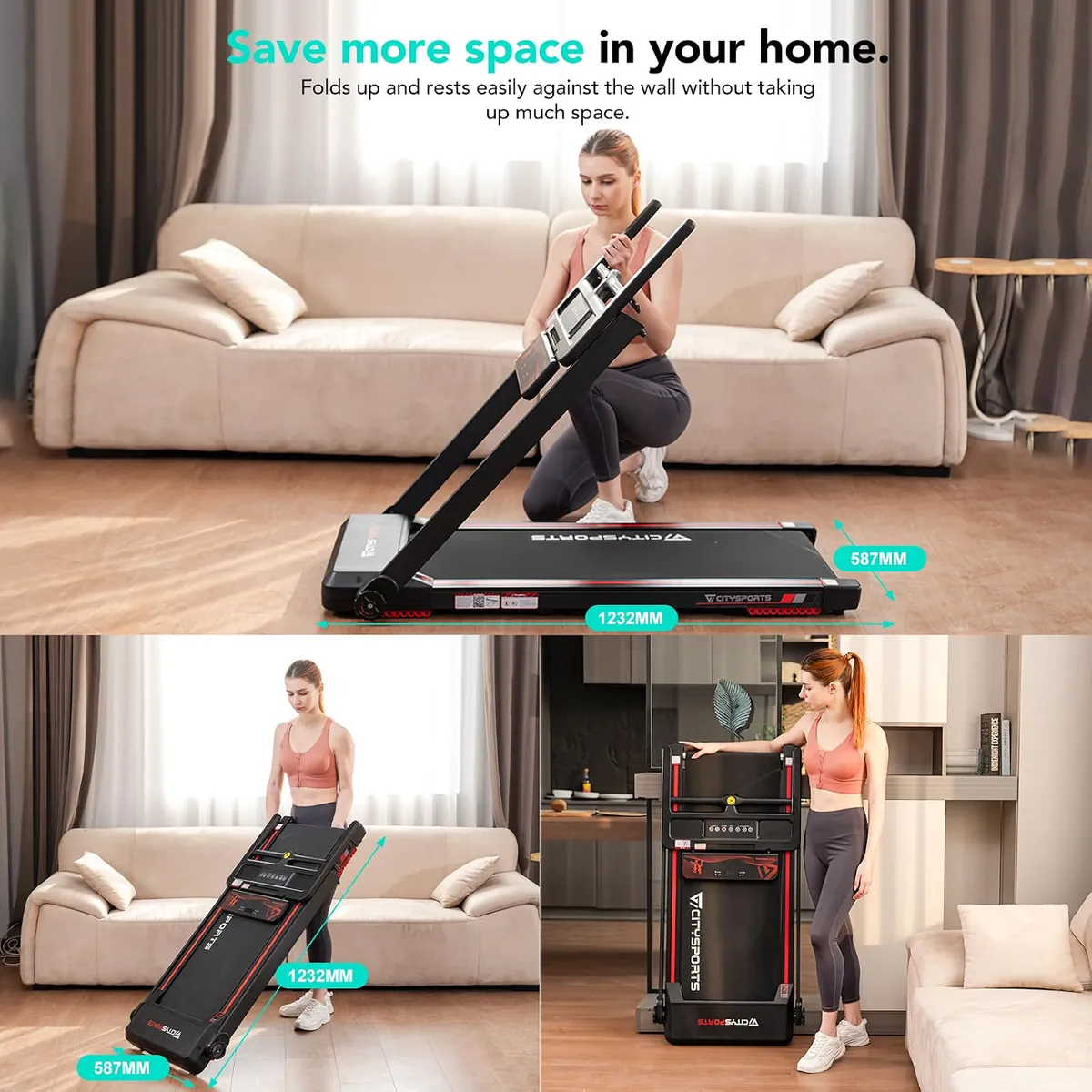
- Stored upright, a folding treadmill must be wedged so it cannot fall on a child who grabs it.
- Objects: toys, balls and cables must not lie near the belt; they can be pulled in and throw the user off balance.
In its warnings about one major brand’s treadmill, the CPSC went as far as advising households with young children to use the machine only in a locked room. Without going that far for a compact treadmill, the idea is clear: sessions take place without children nearby.
The space around the treadmill
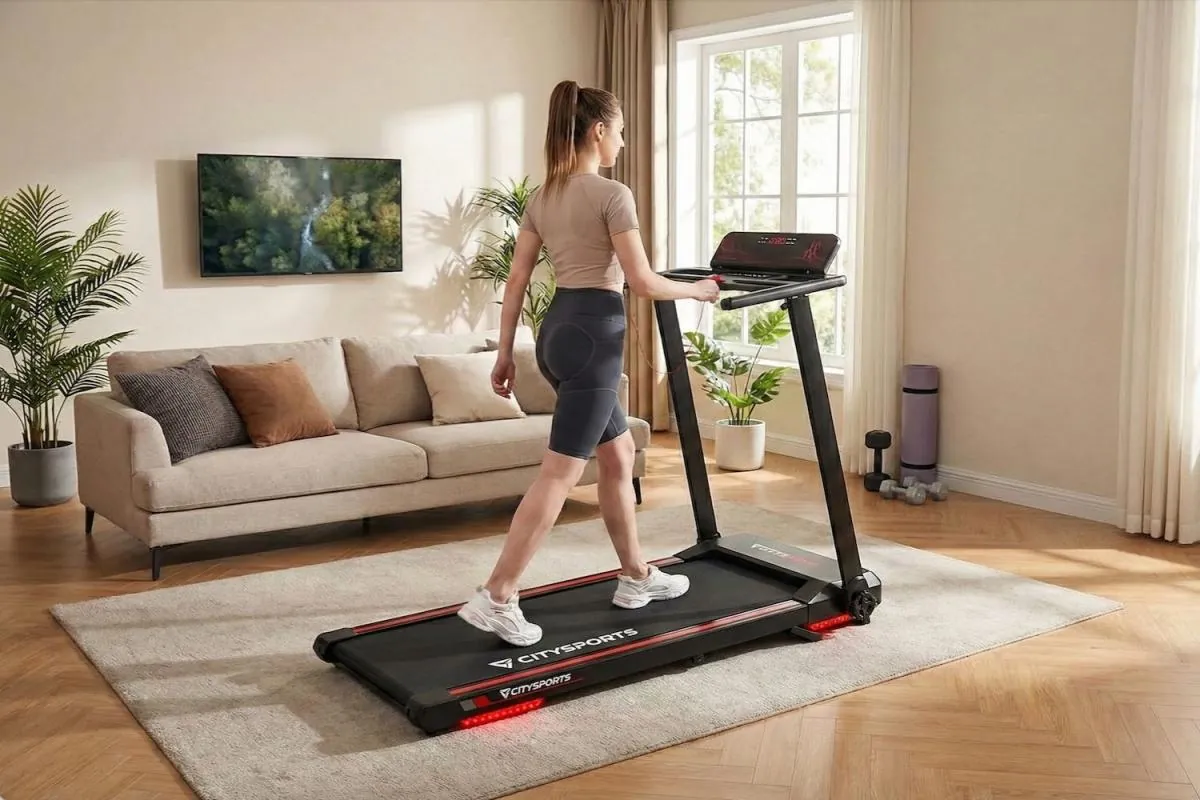
If you fall, the belt carries you backwards. You therefore need clear space behind the machine. Many manuals recommend about two metres of clear space behind the belt and half a metre on each side. Avoid placing the treadmill with its back to a wall, furniture or a patio door.
- Nothing on the floor behind the belt: chair, bag, dumbbells, cable.
- No rug that slides or wrinkles.
- Enough light, especially early in the morning or in the evening.
- No curtain or fabric hanging near the rollers.
Electricity
- Plug directly into an earthed wall socket. Most treadmill manuals advise against extension leads and power strips.
- Route the cord out of the way, never under the belt or under the floor mat.
- Inspect the cord every month: no cuts, no sharp kinks, no overheating.
- Unplug after use, before any work and during storms.
- Keep the treadmill dry: no open bottle above the console, no installation in a damp room.
Folding and storage
A folding treadmill adds two risks: pinching your fingers in the joints, and tipping the machine over when stored upright.
- Always unplug before folding.
- Keep your fingers out of the handrail joints as you fold it down.
- Check that the uprights are locked before each session: they must not move under your hand.
- Stored upright, wedge the treadmill against a wall, somewhere it cannot be knocked over.
- Move it by rolling it, back straight, lifting with your legs.
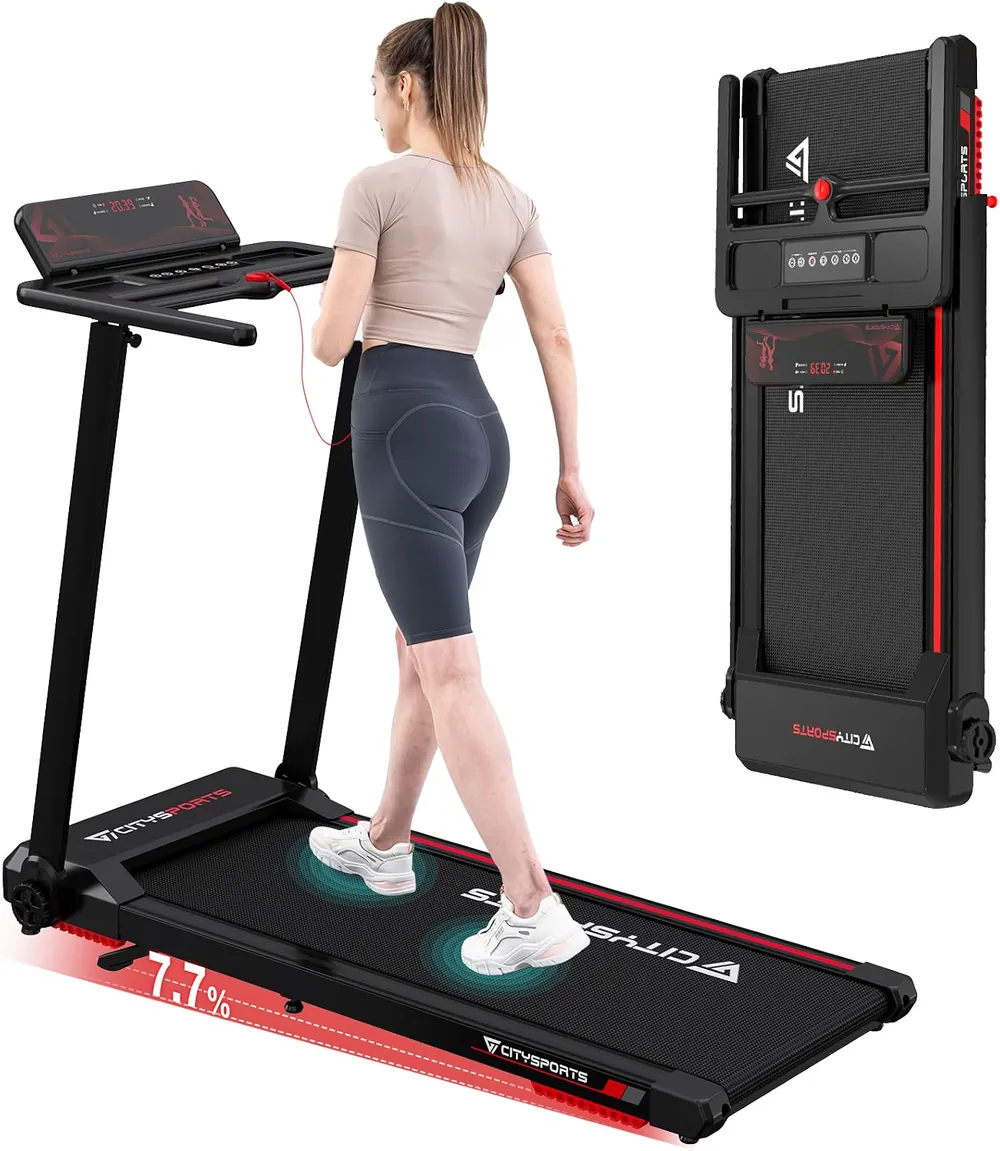
At 26.5 kg, the CITYSPORTS treadmill can be moved by one person, but not at arm’s length: lift the rear and roll it on its front wheels.
Health: listening to the signals
Walking is one of the safest activities there is. Some situations do, however, call for medical advice before starting: heart or respiratory disease, uncontrolled high blood pressure, pregnancy, joint problems, returning after a long break or an operation.
During a session, stop immediately and seek help if you feel:
- chest pain or tightness;
- unusual breathlessness that does not ease when you slow down;
- dizziness, faintness or palpitations;
- sharp joint pain.
Drink water, air the room and avoid intense sessions in an overheated room. In an emergency, call your local emergency number (999 or 112 in the UK).
At the desk and in front of a screen
The French occupational safety institute INRS notes that walking on a treadmill can create a risk of falling, and recommends a risk assessment before installing this type of workstation. At home, this translates into simple rules: slow speed while working, safety key clipped on, belt stopped to turn round or lean over, screen at eye level so you do not look down. Our article walking pad under the desk details how to set up the workstation.
The CITYSPORTS’s equipment
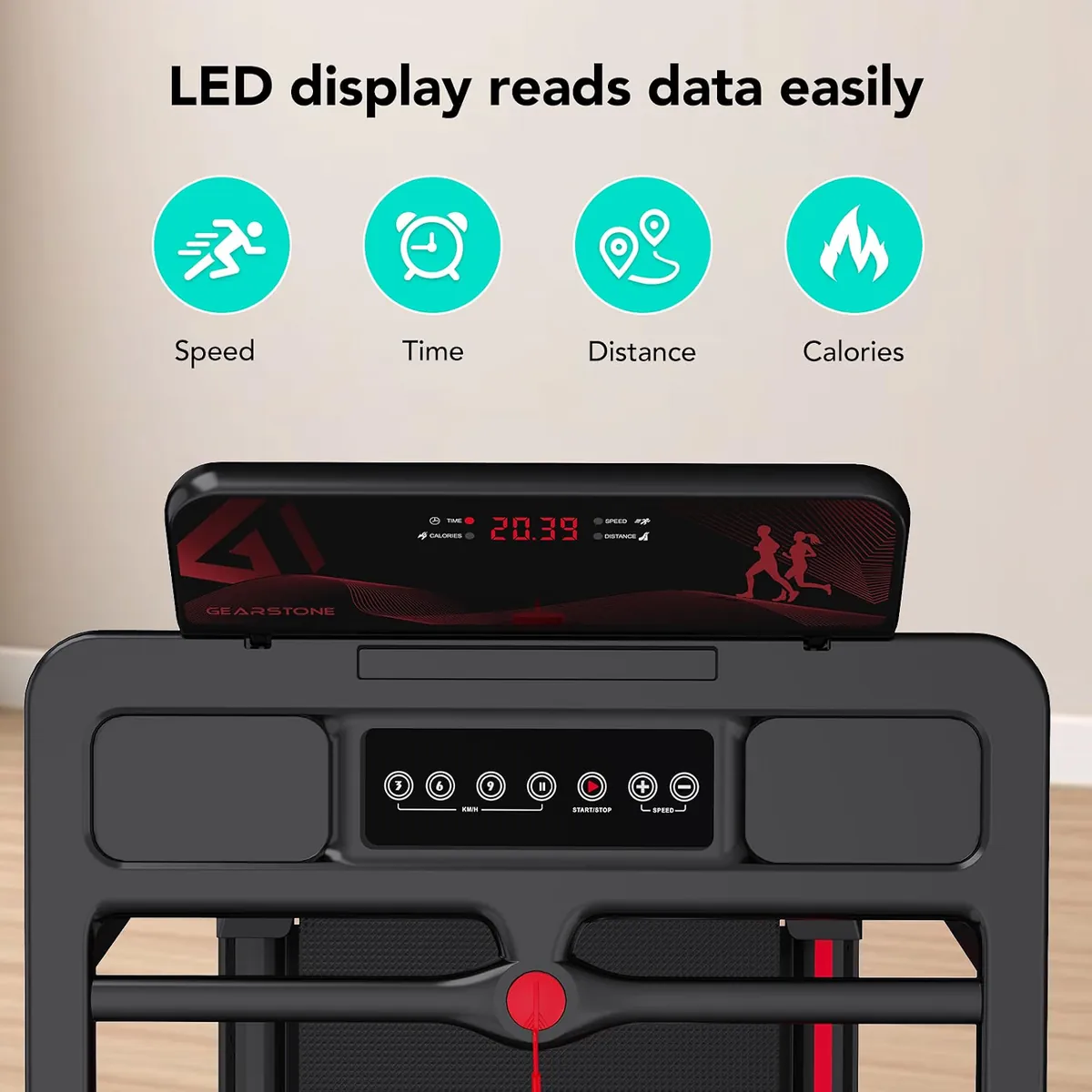
The CITYSPORTS treadmill in our review has a safety key, visible on the manufacturer’s images, a handrail that provides support and carries the console, and a speed that starts at 1 km/h. Its 3, 6 and 9 km/h shortcuts are handy, as long as you do not jump straight from slow walking to 9 km/h. Its maximum load is stated as 120 kg in the description and 110 kg in the specification table: use the lower value.
Its incline is manual, with rear feet: always set it with the treadmill stopped and unplugged, never by leaning over a moving belt. Our full review and our how-to guide detail how to use it.
The safety checklist
- Safety key clipped on every session, removed and hidden afterwards.
- Start straddling the side rails, step onto a slow belt.
- Speed up in steps.
- Closed, clean shoes.
- Two metres of clear space behind the belt.
- Children and pets kept away during the session.
- Direct wall socket, cord out of the way, unplugged after use.
- Handrail locked, treadmill wedged when stored upright.
- Stop immediately in case of chest pain, dizziness or faintness.
- Regular maintenance: a belt that slips or drifts is also a risk. See our maintenance guide.
The most common safety mistakes
- Forgetting the safety key “for five minutes”.
- Stepping onto a moving belt or starting the treadmill while already on it.
- Using a fast shortcut while walking: the acceleration catches you out.
- Looking at your phone while walking briskly or running.
- Leaving the treadmill plugged in with the key in place in a room children pass through.
- Storing the treadmill upright without wedging it.
- Setting the incline with the belt running, leaning towards the back of the treadmill.
- Ignoring a belt that slips or drifts: it can throw you off balance.
None of these mistakes needs equipment to correct: just a habit to adopt from the first week.
Older people and fragile balance
A treadmill can be an excellent ally for staying active as you get older, provided you adapt how you use it:
- Choose a treadmill with a handrail and keep it raised during sessions.
- Start at minimum speed and increase in small steps.
- Always use the safety key, set to come away quickly.
- Do your first sessions with someone nearby while you get your bearings.
- Avoid uphill sessions until walking on the flat is completely comfortable.
- Ask a doctor’s advice if you have dizziness, recent falls, medication that lowers blood pressure or heart disease.
The WHO recommends that people over 65 do varied activities that work balance and muscle strength, to prevent falls. A treadmill fits well with that, alongside a few balance exercises on the floor, next to a stable support.
Guests, visitors and occasional users
A treadmill at home attracts curiosity. Friends, relatives or teenagers may want to try it. Occasional users are more at risk, because they do not know the machine. Before letting someone step on, show them the safety key and clip it to their clothing, start the belt at minimum speed, explain the stop button and the shortcuts, and stay nearby for the first minutes. Do not let anyone try the 9 km/h shortcut as a game.
Frequently asked questions
Can you use a treadmill without the safety key?
No: without the key, the treadmill will not start, and it is what stops the belt if you fall. Never try to bypass it.
What if you lose the key?
Ask the seller or manufacturer for a compatible replacement key. Do not use a magnet or a makeshift object.
Can a child walk on the treadmill?
Home treadmills are designed for adults. Keep children away from the machine, whether it is running or stopped.
How much space should you leave behind the treadmill?
Many manuals recommend about two metres of clear space behind the belt and half a metre at the sides.
Can you plug a treadmill into a power strip?
Most manuals advise against it. Plug it directly into a wall socket.
What should you do if you fall?
If the key is clipped on, the belt stops. Do not try to get up on a moving belt. Check for injuries and see a doctor if needed.
Can you change the incline while the belt is moving?
On a treadmill with a manual incline, no: stop the belt, remove the key and unplug before touching the incline feet.
Can the treadmill start on its own?
No, as long as the safety key is removed. That is why you should remove it and put it away after every session.
Should you hold the handrail all the time?
No. It is for stepping on and off and steadying yourself. Hanging on continuously changes your posture and increases the risk of tripping when you let go.
Is a treadmill stored upright dangerous?
It can tip over if it is not wedged. Place it against a stable wall, out of children’s way.
Can teenagers use a home treadmill?
Home treadmills are designed for adults. If an older teenager uses it, the same rules apply: safety key, slow start, supervision for the first sessions and respect for the manual.
Your next kilometre starts here.
12 km/h · 1400 W · 400 x 1020 mm belt · Bluetooth · No assembly. The price changes often on Amazon: check it, along with the seller and the stated maximum load, before ordering.
Check the price on AmazonAffiliate link · new tab